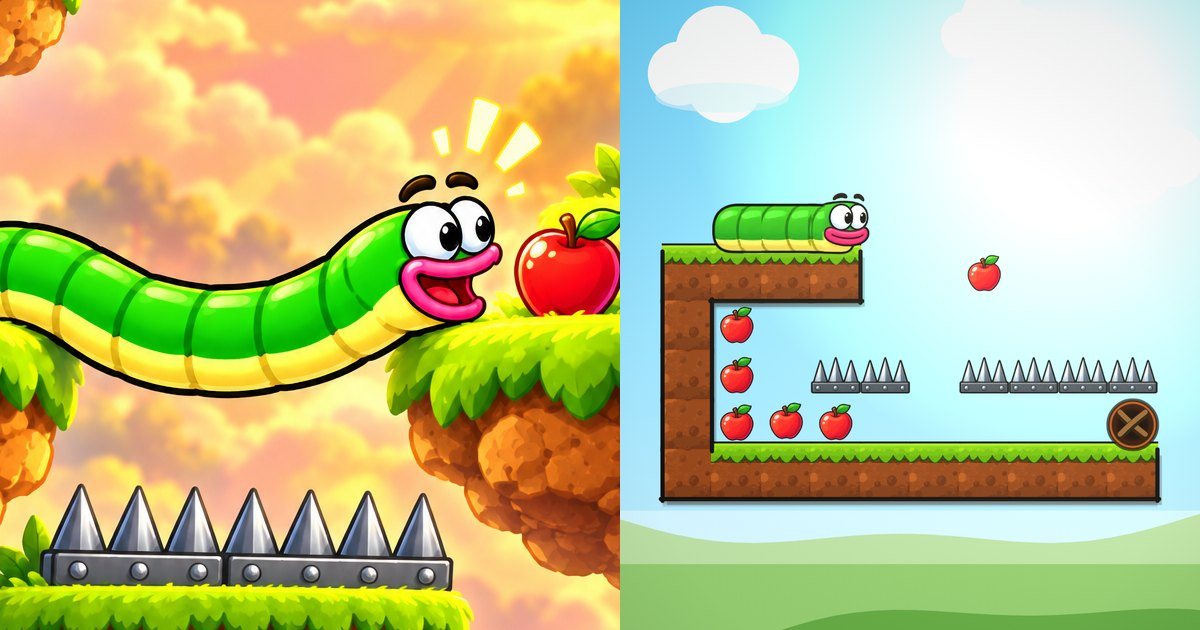
In short. In a gravity snake puzzle, you guide a worm one square at a time across a board seen from the side. It has to eat every apple, then enter its burrow, which stays shut while even one apple is left. Each apple makes it one segment longer. Gravity does the rest: as soon as it stops touching anything, it falls, and the spikes show no mercy. Its best asset is its own body, which gives it something to climb on.
- 1Square per move. The worm crawls, it doesn't jump.
- 7Worlds, from the vegetable patch to the workshop.
- 0Timers. Take your time getting it wrong.
The rule: eat, then go home
The worm moves one square at a time: up, down, left or right. The head chooses, and the body follows exactly in its tracks. It has to eat every apple in the level, then go into the burrow. As long as a single apple is left, the burrow stays shut. Crawling past it achieves nothing: you'll have to come back.
Each apple adds one segment to the worm, straight away: on the move where it takes a bite, its tail stays where it was, and the worm is one square longer at once. It sounds like a trivial detail. Yet it makes or breaks quite a few tight passages: eat an apple just before the way in, and the worm no longer fits.
The worm never turns around: its head can't go into its own body. So a dead end is a death trap, best spotted before you poke your nose in. The good news is that an impossible move costs nothing. Go ahead and try: the counter won't budge.
Gravity, your worst enemy and your best friend
The board is seen from the side, and anything with nothing underneath it falls. The worm stays up as long as just one of its segments is touching something solid: the ground, a crate, an apple it hasn't eaten yet, the burrow. So with support under its tail, it can reach out over the drop without falling, like a living diving board.
When it stops touching anything, it drops in one piece, keeping its shape. It feels like a punishment. It is often the solution: a well-placed fall slips the worm into a gap it could never have reached by crawling.
Above all, its own body is the ladder. The head can rear up one square above the rest, and the worm can climb over itself to go up two storeys or step across a hole. The longer it is, the higher it climbs. The longer it is, the more trouble it has squeezing round corners, too. The worm is a compromise.
One last surprise: the board is a window, not a box. The worm can leave through an edge and come back, and it only dies if it goes entirely below the board. Some levels have no other way through. Yes, that's deliberate. No, it isn't cheating.
What stings, what shifts, what supports
- Spikes kill, whether you crawl onto them or land on them. The fall you thought was safe is their speciality.
- Apples hold the worm up until it eats them. Biting into the one you're standing on means pulling the ground out from under your own feet. Well, your own belly.
- Crates move one square per push, and they fall when nothing holds them up. Pushed off a ledge, a crate becomes a step. Pushed onto spikes, it covers them and makes a bridge. Pushed off the board, it is lost, and the level goes with it.
- A crate against a wall won't move any more: it's a fixed step, on the house.
Crates can never be pulled. Every push is final, and a crate stuck on the wrong side can make the level impossible without warning you. That's what the Restart button is for, and it's free.
The traps everyone falls into
Once you understand the rules, the difficulty no longer comes from the unknown but from the way they combine. The levels are built so that the first idea that comes to mind is wrong. The all-time classics:
- the order of the apples: eating the nearest one first makes the worm longer at the wrong moment, and the next passage won't let it through any more;
- using your own body as a prop: it shifts on your next move, so it doesn't exist;
- the tail that moves on: you're counting on it to hold you up, and off it goes with the rest;
- the load-bearing apple: the floor disappears the moment you bite;
- the one-way fall: you drop down a storey you can't climb back up;
- the blind trap: the mistake only shows three or four moves later, when it is too late to admit it.
The method
- Look before you touch. Find the burrow, the last apple and the path that links the two. The end of the level often tells you where to begin.
- Count your length. Each apple adds a segment. Before you bite, ask yourself whether the worm will still fit where it has to go next.
- Save the highest apple for when you're all grown up. A long worm climbs higher. The apple in the attic is often the last one you eat.
- Look for what holds you up, not what's in front of you. Before each move, check which segment will still be touching something. If none will, you fall, and that may be exactly what you needed.
- Only push a crate if you know where it will land. A pushed crate never comes back. Ask yourself what it will be good for once it gets there.
The mistake that costs the most: moving “just to see”. Here, seeing costs moves, and some moves you never come back from: a pushed crate, a fall, an apple eaten too soon. The level won't tell you it has become impossible. If you've been going round in circles for five minutes, restart: it's free, and your worm has no ego.
Play the level backwards in your head. The worm has to end up in the burrow: which square does it go in from, and in what position? Work back from there. The solution often shows up faster than it does going forwards.
Why every level has a solution, and an honest par
Every Worm level goes through a solver before it's published. The program explores every possible position of the worm, the crates and the apples, and checks two things: that the level has a solution, and that its par is the true minimum, the smallest number of moves that gets you to the burrow. So par isn't a generous estimate from someone who got lucky. It's the best anyone can possibly do.
The solver also measures the traps. A good level isn't a long level, it's a level where the first path that comes to mind fails. You can make a sixty-move level that is mostly walking. We did, we got bored, and we cut out the walking.
Where this kind of game comes from
The snake that keeps getting longer is an old idea. In Blockade, back in 1976, there wasn't even anything to eat: you grew all by yourself. Food arrived with the clones that followed, one of which was already called Worm (we didn't invent a thing, not even the name), and then, from 1997, the snake made its way onto Nokia phones. But that snake lived on a grid seen from above, with no up or down, and its only enemy was its own tail.
Add gravity and everything changes. The best-known game of the genre is probably Snakebird, by the Swedish studio Noumenon Games, released on PC on 4 May 2015 and then on mobile in 2016: snakebirds that grow longer by eating fruit, fall the moment they stop touching anything, and have to reach an exit. It has a reputation for being brutal, and it deserves it.
Since then, the recipe has been picked up by plenty of mobile and web games, often with a worm and apples, several of them under the name Apple Worm. Worm has no connection with any of them. It keeps the basic rule and does things its own way: levels checked by a solver, a par that is the true minimum, and a garden where you can build your own.
In this game
The gesture
Swipe in the direction you want, or use the on-screen D-pad, or the arrow keys. One move per gesture, never more: a long swipe only moves you one square. That way, an overexcited thumb can't send the worm three squares at once, straight into the spikes.
Restart, undo, ask for a hint
Restarting is free, always. Undoing a move costs a short video, one per undo: an ad in the app, and on the website a little carousel of our other games that you can skip after ten seconds. The hint works the same way: it shows the next three moves of an optimal solution from where you are, or tells you straight out that you've hit a dead end.
Stars
Three stars if you match par, two for up to a quarter more moves (always with at least three moves' leeway), one beyond that. Beating par is impossible: the solver saw to that. The leaderboard adds up your stars.
Seven worlds
The vegetable patch to learn the ropes, then the thorns, the traps, the crates, the galleries, the far garden and the workshop. A world opens once you've won a little over half the levels in the previous one: nobody gets stuck behind a single fiendish level.
Your garden
When you've finished every level, an eighth world opens: your garden. There you build your own levels with the game's editor, you play them, and if you're proud of one, you can suggest it. We take a look, and if we like it, it joins the game under your name. Nothing gets published until a human has played it.
Frequently asked questions
How do you play a gravity snake puzzle?
You move the worm one square at a time. It has to eat every apple, then enter the burrow, which stays shut while even one apple is left. Each apple makes it one segment longer, and gravity makes it fall as soon as it stops touching anything.
Why won't the burrow open?
Because there is at least one apple left on the board. The burrow only opens once every apple has been eaten, and then you have to go in head first.
How do you make the worm climb higher?
By using its body: the head can rear up one square above the rest, and the worm can climb onto its own segments. The longer it is, the higher it climbs, which is why it pays to save the top apples for last.
Can the worm go off the screen?
Yes. The board is a window: the worm can go out through an edge and come back, and it only dies if it ends up entirely below the board. Some levels are solved exactly that way.
What does par mean?
It is the smallest possible number of moves to finish the level, worked out by a solver that explored every position. Matching par earns three stars, and nobody can do better.
Can you make your own levels?
Yes, once you have finished every level: an eighth world, your garden, opens with the game's editor. You can play your levels there and suggest one to be added to the game.
Play Worm
Eat every apple, slip into the burrow. Free, no account, works offline.
If you like this one
 One line puzzlesFill · Play now
 Pipe puzzlesRoll · Play now