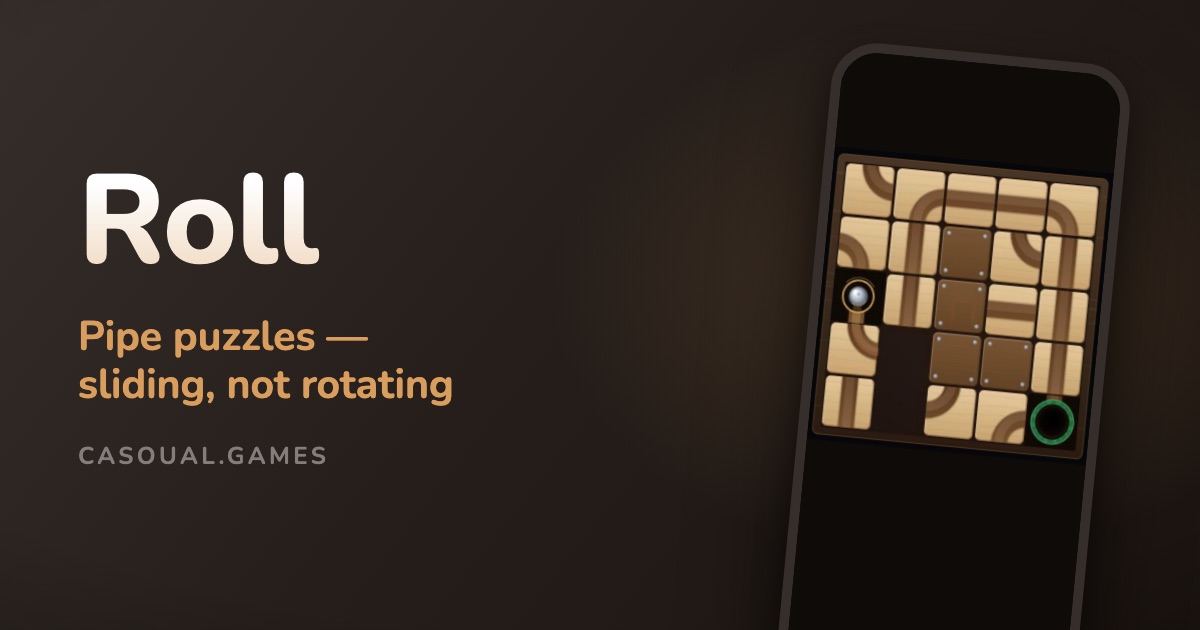
In short. A pipe puzzle asks you to form an unbroken path from an entry to an exit out of straight and elbow segments. Here the orientations are fixed: you never turn a piece, you slide it into the empty square. Two pipes only connect if both are open on the edge they share, and as soon as the route runs unbroken, the ball sets off.
Planning backwards from the exit
The usual instinct is to picture the finished pipe and then push pieces toward it. That often stalls, because a route that would work is not necessarily one you can assemble from where the pieces are now.
Working backwards helps: ask which piece has to occupy the square next to the exit, then which one feeds it, and at each step check whether that piece can really get there, which squares are empty, and what has to move out of the way first.
- 1. The exit. Which shape must sit on the square next to the outlet, and which way round? Look for it on the board exactly as it is: nothing will turn.
- 2. The pieces. Walk the route back piece by piece to the inlet, checking each time that a tile of that shape exists, facing that way.
- 3. The hole’s journey. A tile only moves into the empty square: before moving it, walk the hole to it in your head, and count what has to shift along the way.
Getting better
- Lay the end nearest the entry first, once the route is decided from the exit. Once those segments are in place there is less board left to shuffle, and the empty squares have less ground to cover. Unless those pieces block the gap's path: then clear the corridor first.
- Follow the empty square. A move swaps a tile with an adjacent gap, so the gap is what really travels. Deciding where the gap has to go next is often easier than tracking the tile you want to move.
- Read the move count against par. Par is the shortest solution the level admits, found by exhaustive search when the level is built. It is a floor, not an average: a few moves over is normal, a lot over usually means you are building a different route from the short one.
- Restart without regret. The board has no hidden state and no randomness, so a fresh start costs seconds.
This game is the sliding kind: elbows, straights and crossings whose orientation never changes, on boards that also carry walls and tiles nailed down.
Two puzzles with the same picture
In a rotation puzzle the pieces are independent: turning one never disturbs another. You can settle the top-left corner, be sure it is right, and never come back to it. Most of the work is reading the board, spotting which route the available pieces can actually form.
In a sliding puzzle the moves interfere. A piece only moves into an adjacent empty square, so bringing it where you want it means shifting whatever sits in between, and putting one piece right often displaces another. That makes it an ordering problem, the same family as the 15 puzzle.
Why some boards resist
Sliding puzzles have a parity property, proved in 1879 for the classic 15 puzzle: of all the ways to arrange fifteen numbered tiles and one gap, only half can be reached from a given start. The other half stay unreachable however long you push.
That result is about that specific setup, distinguishable numbered tiles, one gap, nothing fixed. Pipe boards are usually built differently: several empty squares rather than one, walls, tiles nailed in place, and pieces of the same shape that are interchangeable. The parity argument does not transfer to them unchanged, and it is rarely what is actually blocking you.
In this game the levels are generated from a solved position, and every move can be undone by sliding the tile straight back, so no sequence of moves can leave a board unsolvable. A position that feels hopeless still has a solution; undo and restart both cost nothing.
In this game
Controls
Drag a pipe tile one cell into the empty space, or tap it, chevrons mark where it can go; when several directions are free, tap the side facing the hole. Mouse and finger do the same thing. R restarts the level, Escape goes back. There is no undo.
What the board does
One tile, one cell, per move, tiles never rotate, and walls, the source and the goal are fixed. Two tiles connect only if both are open on the edge they share; when the pipe runs unbroken from source to goal, the ball sets off.
Levels, par and stars
Levels come in Easy, Medium and Hard. Par earns the most stars, and a replay never lowers a star you already have.
Hints
A hint outlines where the pipe has to run, never which tile to slide, and is charged once per level.
Frequently asked questions
What is a pipe puzzle?
A puzzle where you form a continuous route from an entry to an exit out of straight and elbow segments. In one family you rotate the pieces where they sit; in the other their orientation is fixed and you slide them around the board.
Do the pieces rotate in this game?
No. Every piece keeps the orientation it starts with, and a move slides one tile into an adjacent empty square. Getting the right shape into a square means bringing that piece to it.
What does par mean?
The shortest solution the level admits, computed by exhaustive search when the level is generated. Finishing at par gives three stars, within three extra moves gives two. Since par is an optimum rather than an average, going over it is common.
Play Roll
Slide the wooden tiles, build the pipe, roll the ball home. Free, no account.
If you like this one
 One line puzzlesFill · Play now
 PolyominoesWoodfit · Play now