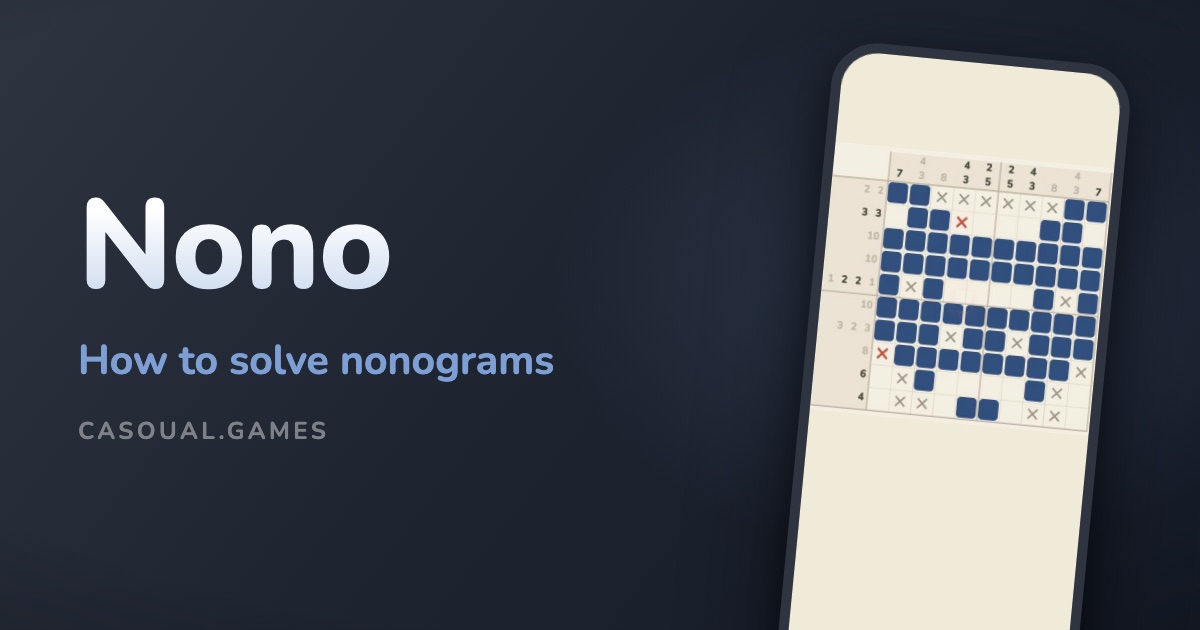
In short. Each number is the length of an unbroken run of filled squares in that row or column, and the numbers are listed in the order the runs appear. Two runs are separated by at least one empty square. The quickest way in is the overlap rule: in a line of length n, a run of length b always covers the middle 2b − n squares, wherever it sits.
What the numbers actually say
A nonogram, also called picross, a griddler, hanjie, or japanese crossword, is a grid where a hidden picture is described entirely by numbers written along its top and left edges.
Read a line labelled 4 2. It says: somewhere along this line there is a run of exactly four filled squares, then later a run of exactly two, in that order, with at least one empty square between them. It does not say where.
Two things follow. A line labelled 0 is entirely empty, which is information you can use rather than a blank. And the minimum room a line needs is the sum of its numbers plus one gap between each pair: 4 2 needs 4 + 1 + 2 = 7 squares. In a line of eight that leaves a single square of slack, and the less slack a line has, the more it can prove.
The overlap rule: where to start
Take a line of 10 squares labelled 8. You do not know where the run of eight starts, but you can test the extremes. Pushed hard left it covers squares 1–8. Pushed hard right it covers 3–10. Either way, squares 3 to 8 are filled, so you can fill them now.
leftmost   ████████··
rightmost  ··████████
certain    ··██████··   ← six squares proved, without knowing the answer
The arithmetic generalises: a run of length b in a line of length n guarantees 2b − n squares in the middle. If that number is zero or less, the run proves nothing yet, which is why the fullest lines are usually the ones to start with.
The same reasoning works with several runs: compute the leftmost possible arrangement of all of them, then the rightmost, and keep whatever agrees.
Take 3 2 on a line of 8. Pushed fully left, the 3 covers squares 1 to 3 and the 2 covers 5 and 6. Pushed fully right, the 3 covers 3 to 5 and the 2 covers 7 and 8. Square 3 is filled in both cases: it belongs to the block of 3 whatever happens. The 2 proves nothing yet: it can sit at 5-6, 6-7 or 7-8.
Mark the empty squares too
An empty square is information; stop treating it as nothing. Beginners fill squares and leave the rest blank. A square you have proved empty is as much of a fact as a filled one, and the next deduction often depends on it.
A crossed square acts as a wall. A line of 10 with a cross at square 6 is almost two lines of 5 and 4: it remains to work out which blocks go on which side, but each is easier to reason about than the original.
Work from the edges
A run sitting at the border has nowhere to slide, so edges are usually the cheapest place to prove something.
- If the first square of a line is filled and the line starts with 3, then squares 1, 2 and 3 are filled and square 4 is empty.
- If the first square is crossed, the line effectively starts one square later and you can redo the overlap arithmetic on a shorter line.
- A filled square next to a cross behaves like an edge, so the crosses you marked earlier keep creating new ones.
Know when a line is finished
When the filled squares in a line already account for every number, everything else in that line is empty, cross the whole remainder at once. Each of those crosses is a wall for the lines that cross it, which is often where the next deduction comes from.
The reverse check is just as useful: if the empty squares already leave exactly enough room for the numbers, the remaining squares must all be filled.
When a grid stops giving anything up
Nono's grids are built to be solved by direct deduction, with no temporary assumption. Other nonograms can have a single valid solution and still require you to assume a square somewhere and follow the consequences.
So when one of ours stalls, there is a deduction left that you have not read. Sweep the fullest rows and columns again, and re-read the lines you have already partly solved: those are the ones whose walls have moved since you last looked.
On a puzzle from elsewhere, stalling may be the puzzle rather than you. In that case, pick a square whose two possibilities resolve quickest and follow one of them until it either finishes the picture or contradicts itself.
The nonogram solver reports which case a grid is in: finished by pure logic, one picture but a guess was needed, or several pictures fit the same clues.
Stuck: what to look at?
- The fullest lines first. That is where overlap proves the most.
- The lines where a wall has moved since your last pass. A cross placed by a column changes what a row can do.
- Blocks that are already complete. Everything touching them is empty, and those crosses are walls for the crossing lines.
- A single free square between two crosses. Either a block of 1 fits there, or it is empty: the numbers decide.
- The count of filled squares. If a line already has all of its own, the rest is empty; if the empties leave just enough room, the rest is filled.
Getting faster
- Start with the biggest numbers. The overlap rule pays proportionally to run length.
- Re-read a line whenever a crossing line changes it. Most missed deductions are old lines with new walls.
- Count before you fill. On a tight line, one subtraction saves several corrections.
- Don't solve the picture. Recognising the subject and then filling squares to match it is a common source of mistakes, only the numbers count.
Where to practise
Nono is a free nonogram game that runs in a browser, on phone or desktop, with no download and no account. It ships 240 boards, from 5×5 up to 15×15, and each one is checked by a solver before it goes in: if it cannot be finished by deduction alone, it does not appear in the game. Solve a grid and it colours itself in to reveal the picture.
In this game
Controls
- Slide along a row or column to fill it, the stroke locks onto that axis even if your finger wanders.
- The switch under the grid picks the tool: filled square or cross.
- To erase, tap a square that already holds that tool; a stroke only paints.
- Undo steps back one stroke, and never rewinds a mistake.
- The bulb reveals the line that proves the most from your board.
What counts as a mistake
- Only a wrong fill costs you: it turns into a red cross you cannot clear and spends a heart. Run out and the board restarts.
- Crossing a square that should have been filled costs nothing, crosses are your notes, never required.
- Stars are the hearts you have left, and a hint costs none.
- Boards unlock in order; the first two teach the rules, and mistakes there don't count.
Frequently asked questions
Is picross the same as a nonogram?
Yes. Picross is Nintendo's name for the same puzzle; griddler, hanjie and japanese crossword are other names for it. The rules and solving techniques are identical.
Do you ever have to guess in a nonogram?
Not in Nono, its grids are built to be solvable without guessing, so being stuck means a deduction has been missed. Elsewhere it depends on the puzzle: a nonogram can have exactly one valid solution and still stall line-by-line reasoning, so finishing it means assuming a square and following the consequences.
What size grid should I start with?
5×5 and 8×8 are enough to get used to counting runs and gaps, and it is the size of the clues that decides what overlap proves there: a 4 on a line of 5 gives three squares at once. From 10×10 upwards the rule works on almost every line. A 15×15, the largest in Nono, is roughly a fifteen-minute sit.
Play Nono
240 nonogram boards in the browser, from 5×5 to 15×15. Free, no account.
If you like this one
 One line puzzlesFill · Play now
 Pipe puzzlesRoll · Play now
 PolyominoesWoodfit · Play now