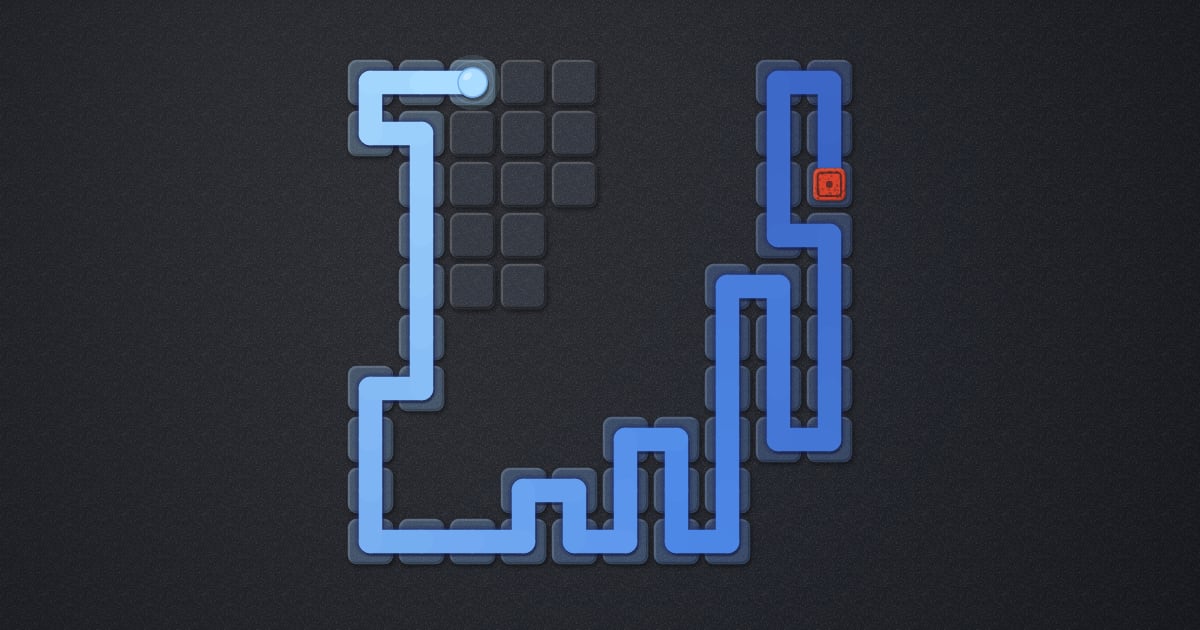
In short. A one line puzzle asks you to draw a continuous line through every square of a board exactly once. You move one square at a time, up, down, left or right, never diagonally, and you never step on a square you have already covered. The start is fixed; the finish is not, so the line ends wherever it likes as long as nothing is left empty.
The three rules that solve almost everything
Three reflexes. And suddenly the grids stop looking like chance.
A one line puzzle is rarely solved by picturing the finished route. It is solved by elimination: at every move some directions rule themselves out, and it is enough to see them.
The dead end
Look at the squares still empty. If one of them has no free neighbour left, it is lost: nothing can reach it any more. If it has exactly one, it can only be the last square of the line, unless the head of the line touches it: then you enter it from the head and leave through that neighbour. And since a line has one end, two such squares mean the game is already over, however open the board may look.
The single exit
From the head of the line, count the free neighbouring squares. If there is only one, the move is already decided: do not think, go. It is the most profitable rule in the game because it chains, one forced move often reveals the next, and long stretches unroll on their own.
The board cut in two
If you only watch one thing, watch this: did your line just cut the board in two? After each move, ask whether the remaining squares still hold together in one piece. The moment your line splits the board into two areas, it is over: the line cannot jump, so it will finish in one and abandon the other. That is almost always how a game is lost, by hugging an edge and sealing a strip of squares off behind you.
Hence the way of playing that works: fill the corners first and keep the open areas for the end. A dead end visited early costs nothing; the same dead end forgotten costs the game.
Getting better
- Sweep the board before you move. Squares with a single exit are the urgent ones: they must be taken now, or become the end of your line.
- Empty the corners early. Any pocket reachable through a single square is a trap if you save it for later.
- Hug edges with suspicion. A line following an edge often seals a strip of squares behind it, without it showing at the time.
- Go back early rather than late. Retracing costs nothing and does not count as a mistake; it is the normal gesture of the game.
- Use the hint to understand, not to advance. When it says the mistake was seven moves back, look at the line before rewinding: that is where you learn to see the split coming.
What parity does not explain
You will often read that a parity argument solves these grids. The idea: colour the board like a chessboard; since the line necessarily alternates between the two shades, too large an imbalance between light and dark squares makes the board impossible.
True, but only before you start. Once the game is under way the argument is useless, and that is provable: on a grid, every neighbouring square is the opposite colour. Each move therefore removes exactly one square of the colour that had to go, and flips the head of the line onto the other shade. The balance is invariant, it cannot break along the way. The count tells you a board is playable; it will never tell you your line went wrong.
So what defeats you is never parity: it is almost always a stranded square, or a board cut in two.
One line and Euler trails: two problems people confuse
Two families of games go by “draw it in one stroke”, and they are not equally hard.
In the games called one stroke, you travel along lines already drawn, each segment must be used once, and junctions may be revisited. That is an Euler trail, and it has an immediate test: there must be zero or exactly two points where an odd number of segments meet. So you can tell at a glance whether a figure can be traced.
Here you travel across squares, each one once. That is a Hamiltonian path, and no such test exists: deciding whether an arbitrary board admits one is a famously hard problem with no known shortcut. Which is why these grids are played by elimination rather than by calculation, and why the rules above are worth more than a formula.
In this game
Controls
Put your finger on the seal and drag: the line follows. To go back, retrace your own line square by square, or press undo, which steps back once. Any other square you have already inked is ignored: you do not cross your own path, which is the rule of the game and the rule of the interface too. On a keyboard, the arrows draw, Z undoes, H asks for a hint.
The board
The board is not a rectangle: it is a silhouette cut out of the grid, with arms, narrow necks and bites taken out of it. Those edges are what make a level solvable by reasoning, a full grid offers too many routes, a silhouette forces a handful.
The three difficulties
They differ by a measurement rather than a size: the success rate of a player who reasons but never backtracks, computed over hundreds of simulated attempts when the level is built. On easy that player gets through nine times out of ten; on hard he fails four times out of five. The first levels are not riddles, they are the rule, put in your hand.
The hint
One button, two answers. If the line can still lead somewhere, the hint shows the next forced squares, never an arbitrary choice, and names the rule that forces them. If the line is already lost, it tells you how many moves ago: “your mistake was seven moves back”, and offers to rewind there. The game never volunteers that you have lost: you have to ask.
Frequently asked questions
What is a one line puzzle?
A grid where you draw a continuous line through every square exactly once, moving one square at a time horizontally or vertically. You never step on a square already covered, and the board is full when the line has visited them all.
Do I have to finish on a particular square?
No. Only the start is fixed. The line stops wherever it likes as long as no square is left empty, which leaves far more possible solutions than a grid with a fixed finish, and makes the reasoning less mechanical.
How do I know if I have already lost?
The game does not say so on its own, deliberately: being told would spoil the discovery. The hint button answers when asked, either it shows the forced squares, or it tells you how many moves back the mistake was and offers to rewind.
Does every level have a unique solution?
No, and it does not need one. A board may admit several valid routes; what matters is that it admits at least one from the fixed start, which is checked when each level is generated.
How is this different from one stroke games?
Those have you travel along lines already drawn, each segment once: that is an Euler trail, with a simple test for whether a figure can be traced. Here you travel across squares, each once: that is a Hamiltonian path, for which no such test exists.
Play Fill
One line, every square, never twice on the same one. Free, no account.
If you like this one
 Pipe puzzlesRoll · Play now
 PolyominoesWoodfit · Play now