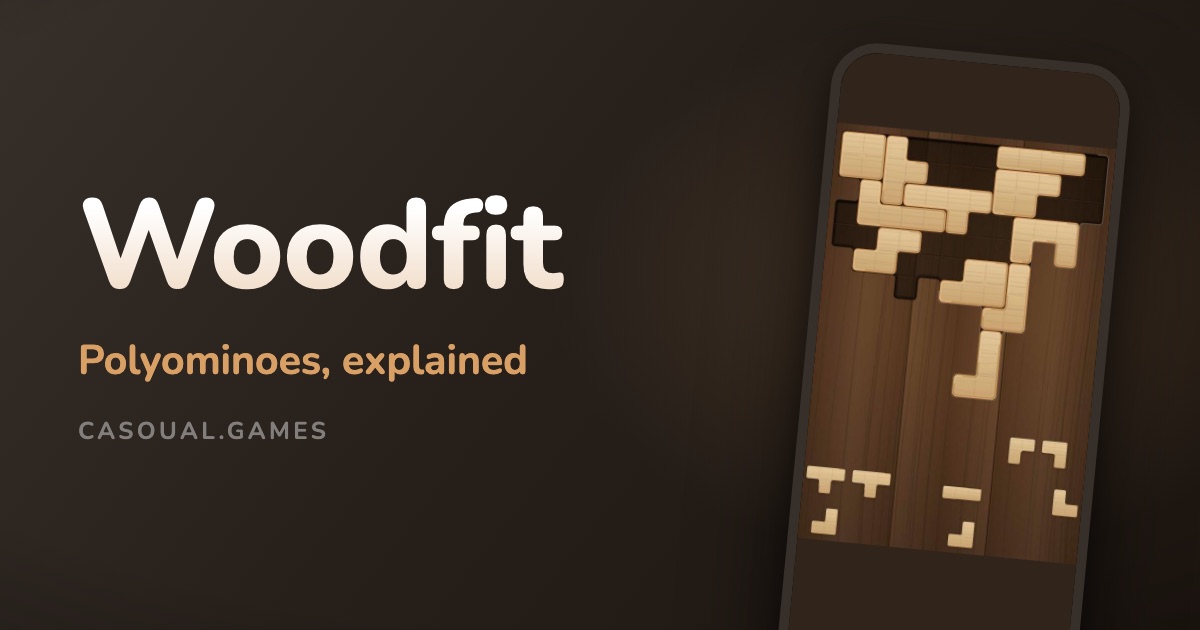
In short. A polyomino is a shape made of unit squares joined edge to edge. Four squares give the tetrominoes: there are five free tetrominoes, or seven if you count mirror images separately, as Tetris does. Five squares give the twelve pentominoes, the classic puzzle set. Fitting a set of pieces into a fixed outline is what block-fitting games ask you to do, and in general the problem is NP-complete.
How many are there?
The word itself comes from the mathematician Solomon Golomb, who named the family in 1953 and turned it into a research topic in its own right.
The count grows fast and no formula is known for it; the numbers below come from exhaustive computer enumeration. Two shapes count as one when a rotation or a reflection turns one into the other.
| Squares | Name | How many |
|---|---|---|
| 1 | monomino | 1 |
| 2 | domino | 1 |
| 3 | tromino | 2 |
| 4 | tetromino | 5 |
| 5 | pentomino | 12 |
| 6 | hexomino | 35 |
| 7 | heptomino | 108 |
| 8 | octomino | 369 |
Tetris uses seven pieces rather than five because it treats mirror images as distinct: S and Z, and J and L, are reflections, and on a flat screen no rotation turns one into the other.
The parity trick
One check rules out impossible puzzles before you place a single piece. Colour the target region like a chessboard, then count.
Some pieces cover the same number of dark and light squares wherever they sit; others cover an unequal split, which can tip one way or the other depending on where they sit. Run through what your set of pieces can cover and compare it with what the region actually has. If the totals cannot match, no arrangement exists.
It is the same argument that shows a chessboard with two opposite corners removed cannot be covered by dominoes: the two missing squares share a colour, leaving 30 of one and 32 of the other, and every domino takes one of each.
Reading a fitting puzzle
- Place the awkward pieces first. Long straights and crosses often have the fewest positions that work; the small compact ones fit almost anywhere and can wait.
- Start at the corners and edges. They have the fewest ways to be covered, so they settle early.
- Watch for a stranded single square. A one-square gap that nothing can fill means the arrangement is already dead, so restart instead of continuing.
The twelve pentominoes
The twelve pentominoes carry letter names for their shapes: F, I, L, N, P, T, U, V, W, X, Y, Z. Together they cover 60 squares, which is why the classic challenge is to tile a 6×10, 5×12, 4×15 or 3×20 rectangle with all twelve.
The 6×10 rectangle has 2 339 distinct solutions, counting those that map onto each other by symmetry only once. The 3×20 has 2. Same pieces, same area: the shape of the frame alone accounts for the difference, and it is what makes one board of a fitting game forgiving and another almost rigid.
Why fitting is hard
Deciding whether a set of polyominoes tiles a given region is NP-complete. Past small boards there is no known shortcut: a classic approach is to place a piece, backtrack when the placement fails, and try the next one.
Woodfit, as the rules above say, never rotates or mirrors a piece. That shrinks the search, since every piece has a single orientation, but it also removes the usual fix of turning an awkward shape, so a hole of the right area can still have no solution.
In this game
Controls
Drag a piece from the tray into the carved hollow. A ghost shows where it lands when the spot is legal; otherwise the blocking cells turn red and the piece goes back to the tray. Tap a placed piece to pop it back, or drag it straight elsewhere. Top bar: back on the left, hint bulb and restart on the right, they fire when you lift your finger, so slide off to cancel.
Rules
Pieces are never rotated or mirrored: they go in exactly as they sit in the tray. Every hollow has a solution. Three stars means no take-back at all. The hint bulb frees the fewest blocking pieces and places one for good, a rewarded video in the app, and it costs you no star. Progress is kept server-side and follows you to a new phone.
Frequently asked questions
Why can I not fit the pieces even though the area is right?
Matching area is necessary but not sufficient. Shade the region like a chessboard and count what each piece must cover: if the dark and light totals cannot balance, no arrangement exists at all.
Does Woodfit rotate or mirror the pieces?
No. Every piece drops into the carved shape in the orientation you see, and the boards are generated so that a solution exists under that constraint. If a piece looks wrong for a gap, it is the wrong piece for that gap.
Why does Tetris have seven pieces if there are only five tetrominoes?
Because Tetris counts mirror images as different pieces: S and Z, and J and L, are reflections that cannot be rotated into each other on a flat screen. Five free tetrominoes become seven one-sided ones.
Play Woodfit
Fit every piece into the carved shape. Endless boards, free, no account.
If you like this one
 One line puzzlesFill · Play now
 Pipe puzzlesRoll · Play now