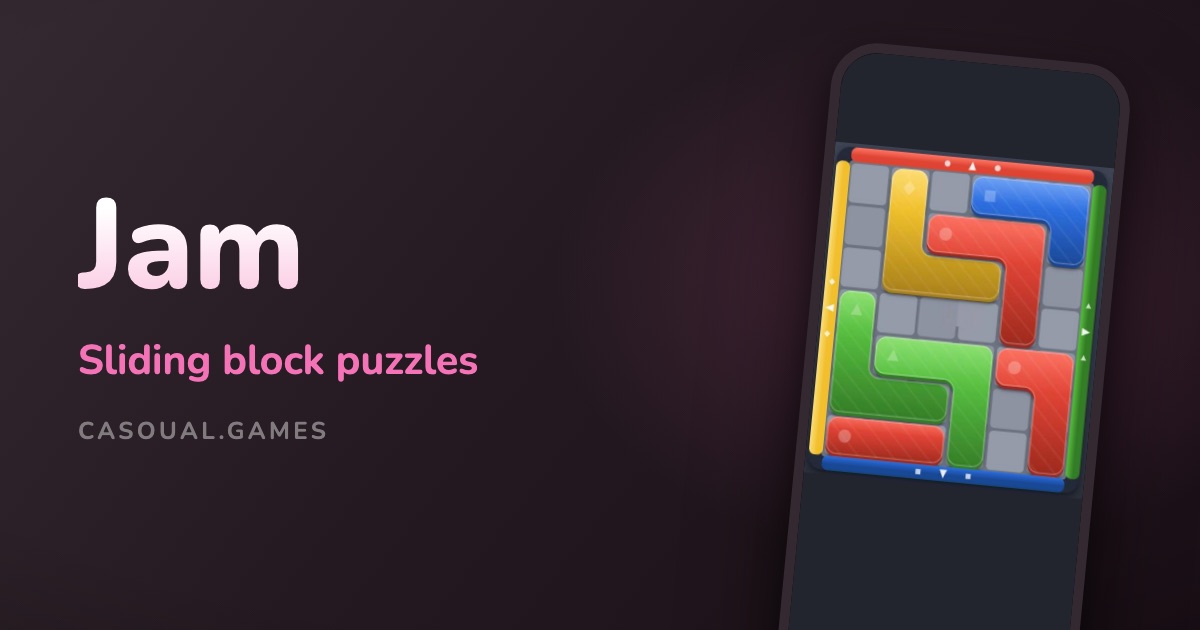
In short. A sliding block puzzle gives you pieces that move only by sliding: they cannot be lifted out or rotated, and the frame has very little spare room. What makes it hard is the order, since freeing one piece usually means moving others into the way first. Rush Hour, first sold in the United States in 1996, is the version most people know. The colour-gate variant gives each block its own exit, so every piece has to leave rather than just one.
Colour gates
The modern variant of these puzzles, popularised by mobile hits such as Color Block Jam, changes the goal. Where the classic puzzles free a single piece, every piece has to leave, each through the gate matching its colour.
That changes how you plan. In Rush Hour you clear a path for a single target and everything else is an obstacle. With colour gates, a piece you have not moved yet is both something to get out and something in the way, so the order matters: sending one block out early can close the only lane another colour had.
How to read a jammed board
- Work back from the gates. Rather than looking for the piece that moves most easily, pick a piece you want out and ask what has to be elsewhere before it can travel all the way to its gate.
- Look for what is holding the jam. When nothing much moves, it is often a long piece lying across the only free lane. Work out what would have to shift for it to move at all, even if that means undoing a move you liked.
- Measure your room to manoeuvre. When almost no square is free you will rarely have more than one useful move at a time. With three or four you have room to shuffle, and the difficulty is somewhere else.
- Restart early. A wrong line feels like progress while you are in it, and restarting costs nothing. If twenty moves have not freed anything, reset instead of pushing on.
A concrete example: red block A has to leave through the left, but blue block B is in front of it. B can move up, except that the only free square above B is also green block C’s only way out. Moving B dooms C. So the solution starts with C, which seemed to bother nobody: clear C, move B up, get A out.
Every level is built by an exact solver that guarantees a solution using a single drag per piece; par is that number plus a small allowance.
What makes them hard
Nothing is hidden. The whole board is visible, there is no randomness, and every legal move is right in front of you. The pieces still get in each other's way for a long time.
The reason is that the moves are not independent. In most puzzles you can work on one corner and leave the rest alone. Here the only way to free a piece is to push others somewhere, and wherever they land they block something else. That also makes a wrong line hard to spot: twenty moves into a dead end feels much like twenty moves of progress.
Deciding whether a general sliding block configuration can be solved is PSPACE-complete, so it is a hard problem for computers as well.
A short history
The ancestor is the 15 puzzle, which swept America in 1880: fifteen numbered tiles in a sixteen-square frame. Sam Loyd claimed credit and offered a prize for solving an arrangement that was mathematically impossible, which did the puzzle no harm at all.
Sam Loyd promised a thousand dollars to anyone who could put back in order two tiles swapped at the start. Nobody ever collected: the position is mathematically unreachable, which he most likely knew perfectly well.
Lewis Hardy's Pennant Puzzle, copyrighted in 1909, then replaced numbered tiles with rectangles of different sizes; Dad's Puzzler popularised it in 1926. It is the shape the genre still uses. Nob Yoshigahara designed Rush Hour in the 1970s and it was first sold in the United States in 1996, adding two rules that stuck: pieces slide only along their own axis, and one specific piece has to reach the exit.
In this game
Controls
Drag a block with a finger or the mouse: it follows your pointer one cell at a time and stops against whatever it meets. A drag can turn a corner and still counts as one move. Bring it to a gate of its own color, fully inside the opening, and it flies out. Undo (Z), restart (R), and back to the level grid.
The rules it applies
- No rotation: shape and orientation are fixed.
- A block only leaves through a gate of its own color, and only if its full span fits between the ends of the opening.
- The way out must be clear: every cell it sweeps through has to be empty.
- Dark hatched cells are fixed blockers and never move.
- No timer, no move limit: par only decides your stars.
Levels and stars
Levels unlock one at a time, and your leaderboard score is your total stars.
Frequently asked questions
What is the difference from Rush Hour?
In Rush Hour a single target piece must reach one exit and everything else is an obstacle. In the colour-gate variant every piece must leave through the gate matching its own colour, so the order in which you release them becomes the puzzle.
Can the pieces be rotated or lifted out?
No. Sliding is the only move: a piece keeps its orientation and travels through free squares until it reaches a gate of its colour. That restriction is what the whole genre is built on, from the 15 puzzle onwards.
Is this the same kind of puzzle as Color Block Jam?
Yes, it uses the same colour-gate mechanic: every block leaves through the gate matching its colour, and the order you release them is the puzzle. Jam is a free browser version of the format.
Play Jam
A thousand boards, from open frames to six-colour gridlocks. Free, no account.
If you like this one
 One line puzzlesFill · Play now
 Pipe puzzlesRoll · Play now