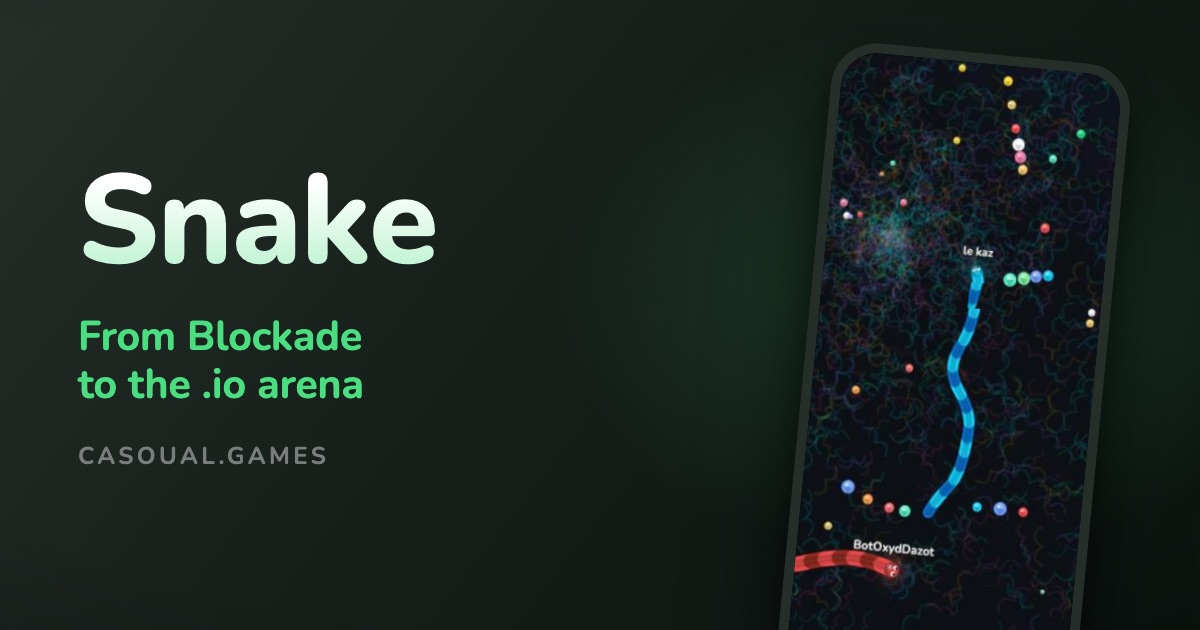
In short. The mechanic first appeared in Blockade, a 1976 arcade game by Gremlin Industries. It spread through home computers under a dozen names, then reached a very large audience in 1997, when Nokia shipped a version by Taneli Armanto on the 6110. In 2016, Slither.io replaced the walls with other players, bringing Snake into the browser arena format Agar.io had started a year earlier.
1976: two snakes, no apples
Blockade was a two-player arcade game. Each player left a solid trail behind them, and the loser was whoever hit a wall or a trail first. There was nothing to eat: you grew automatically, and the board filled up until someone ran out of room.
Without food, the only thing filling that board is the trail the two players have already laid down. Later versions added an apple and dropped the second player, but they kept that part.
Blockade was cloned within months, and the mechanic spread through the home computer era with no single version winning out. That is why Snake became a genre rather than a signed game, and why it goes by a different name almost everywhere you look.
- 1976. Blockade. Gremlin Industries. Two players, growing trails, no food.
- 1977–1982, the clones. Worm, Surround on the Atari 2600, Nibbler in arcades. Food appears in this period, which hands the player control over when they grow.
- 1982. Tron. The light cycle sequence puts Blockade's idea back in an arcade cabinet, this time on motorbikes.
- 1997. Nokia 6110. Taneli Armanto adapts Snake for a screen of 84×48 pixels. Nokia has put the number of handsets it eventually shipped on at more than 400 million.
- 2015. Agar.io. Matheus Valadares launches a browser game where everyone shares one map: you eat smaller cells and avoid bigger ones. This is where the .io wave starts.
- 2016. Slither.io. Steve Howse applies the same idea to Snake. Dying leaves your mass on the ground for someone else to eat.
Why the Nokia version mattered so much
Snake on the 6110 was not the most elaborate version of the game. What it had was position: in a pocket, on a device with almost nothing else to do on it.
The design fitted the hardware. No loading, no save, no story, and a session that ends whenever you need it to. It is often described as a one-button game, which it was not: the 6110 manual documents steering on the number keys, 2 and 8 for up and down, 4 and 6 for left and right.
Difficulty you make yourself
Snake's difficulty comes from the player's own success. Nobody sets the pace: every apple lengthens the tail you then have to avoid, so a good run gets harder on its own. That is enough to keep a run tense without levels or a difficulty setting.
2016: when the walls became other players
Slither.io kept the snake and changed the hazard: not the wall or your own tail, but the other players. It followed Agar.io, released a year earlier, which is where the format came from. These are the games now called .io games, after the domain Agar.io launched on: free, in the browser, no account, everyone in the same arena.
What changes for the player:
- Length stops being purely good. A long snake still has reach and mass, but it is also a bigger target and it turns more slowly.
- A death is food. A dead snake drops its mass where it fell, so the biggest piles on the board come from someone else's mistake.
- You can hunt. Whoever's head touches a body is the one who dies, so cutting in front of a snake kills it whatever its size.
This version keeps that structure: a shared arena, a boost that costs you mass, and nineteen bots when you play alone so the board is never empty.
How to survive longer in the arena
- Circle, don't chase. Coming at a snake your own size head-on rarely works. The usual way to get a kill is to curve around one that is already busy eating.
- Boost costs you mass. Holding boost drops your own points behind you, so it is worth spending to escape or to close a kill, rarely to travel. Boosting to reach food often costs more than the food gives back.
- Use the border carefully. It limits the directions you can be attacked from, which helps while you are small, but touching it ends the run. Keep enough room to turn.
- Arrive after the fight. Mass from a kill stays on the ground, so you do not need to be in the collision to get something out of it.
In this game
Controls
- Touch: drag a finger anywhere on the screen. The joystick anchors where you touched.
- A second finger, anywhere, boosts, lift it and the boost stops.
- Mouse: hold the button down and drag where you want to go.
- Keyboard: arrows or WASD to steer, Space or Shift to boost.
- The back button pauses the run.
The rules
Your head touching another snake's body kills you, your own tail is harmless, so you can coil through yourself. The arena is a circle: cross the edge and you die. Killing pays nothing by itself; a dead snake drops food along its length, and you still have to go and eat it. A fresh spawn is briefly immune.
Solo and online
- Solo pits you against bots with different behaviours; online is real players plus bots run by the server.
- Boost drops pellets off your tail and subtracts those points from your score. Bots boost for free.
- Best scores are kept separately for solo and online.
Frequently asked questions
Who invented Snake?
Nobody owns it. The mechanic first appeared in Blockade, made by Gremlin Industries in 1976, and was cloned so widely that Snake became a genre rather than a signed game. The mobile version most people remember was adapted for Nokia by Taneli Armanto in 1997.
What was the Snake game on old Nokia phones?
A version written for the Nokia 6110 in 1997, which Nokia says went on to ship on more than 400 million handsets. The 84×48 pixel screen meant no loading and no saving, and you steered with the number keys: 2 and 8 for up and down, 4 and 6 for left and right.
What is the difference between Snake and Slither.io?
In classic Snake you play alone against a score, and the hazards are the walls and your own tail. In the arena format the hazards are the other players and the edge of the map: you die by running into a body, you kill by cutting across a path, and a dead snake's mass is left on the ground for anyone to eat.
What is a .io game?
A family of multiplayer browser games popularised by Agar.io: usually free, no account, everyone in the same arena. Agar.io started the format in 2015 and gave it its name, after the .io domain it launched on. Slither.io brought Snake into it the following year.
Play Snake
Solo against nineteen bots, or a live arena with real players. Free, no account.
If you like this one
 How Drift worksDrift · Play now
 Racetrack, the paper racing gameDotrace · Play now