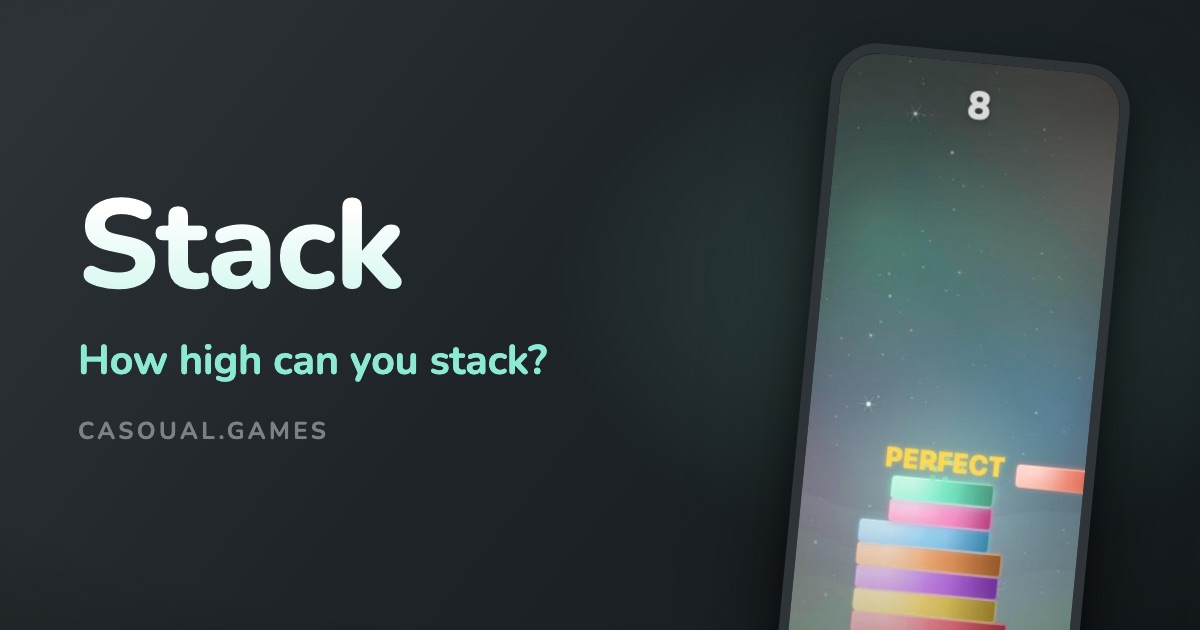
In short. The block slides on its own. Tap to drop it. Whatever overlaps the block below stays; the overhang falls off and the tower narrows. Land within six pixels and it counts as perfect, nothing is lost, and consecutive perfects widen the tower back. Miss the tower entirely and the run ends.
The principle: every mistake makes the next one harder
Games of this type runs the same loop: a block travels, you stop it, and the overlap becomes the new top of the tower. You never steer the block, the only decision is the moment of the tap. And the cost is arithmetic: a drop that hangs over by ten pixels costs ten pixels of width, and you carry that loss for the rest of the run.
Most stacking games hand some of that width back when you place several blocks perfectly in a row. Stack does too, and the numbers are below.
The lineage is short. Tower Bloxx, on the phones of 2005, already had a floor swinging at the end of a crane; Stack, by Ketchapp, in 2016, cut the gesture down to a tap and the block to a rectangle crossing the screen. That is the version everyone copied, and the one Stack takes up.
Controls
Tap or click anywhere on the play area to drop the block. On a keyboard, Space and Enter do the same thing. That is the whole control scheme, nothing to aim, nothing to hold down.
What each drop does
- The block enters from one side, crosses the play area and bounces off both edges. The area is capped at 480 pixels wide, so a phone and a desktop get the same game.
- Each new block arrives from the side opposite the last one.
- The part that overlaps the block below stays. The overhang is cut off and falls away.
- Within six pixels, the drop is perfect: the block snaps into place at full width and nothing is cut.
- From the second perfect in a row the tower grows back, 3 pixels, then 6, then 9, up to the width you started with, 45% of the play area.
- One imperfect drop resets the streak to zero.
- The run ends the moment a block misses the tower completely. That is the only way to lose: no lives, no continue.
Score, speed and records
One point per block placed, perfect or not, perfects buy width, not points. They are counted separately and shown on the end screen, along with your best streak from three upwards. The on-screen label grows with the streak: PERFECT, then GREAT! at three, AMAZING! at five, INSANE!! at eight.
Your best score is kept in the browser, and the home screen re-checks it against the online top ten, if you have entered a name, clearing your cache does not cost you your record. No ad ever interrupts a run: the interstitial appears on the end screen only, and at most every three games. Stack is also in the Pause app on Android, where it runs offline.
How to beat your record
- Watch the edges, not the block. What matters is the alignment of the two edges; fix your eye on the tower’s, it does not move.
- Go for perfects early. Six pixels of tolerance on a wide block is comfortable; the same gap on a block already trimmed no longer forgives. The perfect streaks that give width back are built at the start.
- Accept losing a little rather than a lot. A block placed two pixels off costs two pixels; a block placed late costs thirty. When doubt arrives, tap.
- Speed rises with the score. The rhythm of the first ten floors is not the fortieth’s: reset your timing rather than keeping the same gesture.
Frequently asked questions
How wide is the perfect window?
Six pixels. The falling block and the one below are always the same width at that moment, so six pixels of misalignment, in either direction, is the entire margin.
Do perfect drops score more?
No, a perfect is worth the same single point as a sloppy one. What it buys is width: nothing is cut, and from the second in a row the tower grows back.
Can a narrow tower get wide again?
Yes, but slowly: 3 pixels for the second consecutive perfect, 6 for the third, 9 for the fourth, capped at the width you started with. A long streak is the only way back.
Is there an ending?
No. Stack is endless, with no levels and no difficulty setting. The run stops on the first block that misses the tower completely.
If you like this one
 The history of SnakeSnake · Play now
 How Drift worksDrift · Play now
 Racetrack, the paper racing gameDotrace · Play now