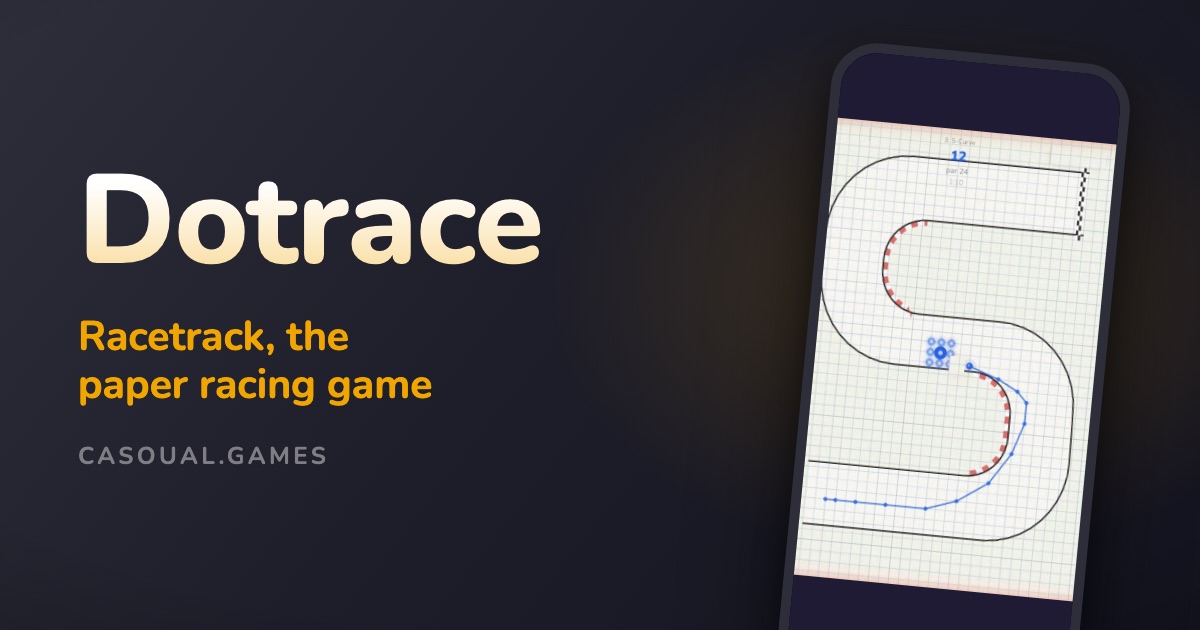
In short. Racetrack is a two-player pencil-and-paper game played on graph paper. Each player draws a circuit, then moves a car one grid point at a time. Your move is a vector: the direction and speed you had last turn carry over, and you may adjust them by one square horizontally and one vertically. Leave the track and you stop dead and lose a turn. First car across the finish line wins.
What you need
Graph paper, one pen per player, and two minutes to draw a circuit. Draw a closed loop, any shape, as long as it has an inside and an outside, and mark a start line across it. Wide corners give an easy track, tight hairpins a hard one.
Each car starts on a grid point on the start line, at a standstill.
How a move works
Your car has a velocity: how many squares it travelled horizontally and vertically on the previous turn. On your turn, you may change each of those two numbers by at most one. The car then moves by the new velocity, and you mark the new point.
previous velocity  (3, −1)   →  3 right, 1 up
allowed next       (2…4, −2…0)
you pick           (4, 0)   →  the car travels 4 right, 0 up
From a standstill the first move takes you at most one square in any direction, diagonals included. Speed then builds one square per turn. A car travelling six squares a turn needs six turns to come to a stop, and can only shift its line by one square per turn while it does.
Leaving the track
If the straight line between your last point and the new one crosses the edge of the circuit, you have crashed. The usual penalty is the mild one: the car goes back to the last point that was on the track, its velocity resets to zero, and the turn is spent. Some groups eliminate you instead, agree which before you start.
What happens when two cars meet is a convention to settle before the start, like leaving the track: the most common one forbids two cars from finishing a turn on the same grid point, and counts no collision beyond that.
How Dotrace adapts it
Dotrace plays the paper rules as they are. Each turn it shows the nine points you are allowed to move to, last turn's velocity, plus or minus one square on each axis, and you tap one. Points that would take you off the track are drawn as small crosses, so an impossible corner is visible before you commit to it.
What changes is the drawing rather than the rules: circuits are handmade, with curved borders instead of a line traced along the squares. A crash costs what it costs on paper, the ball stays where it is, the velocity drops to zero, and the turn counts. Undo takes back the last move, including a crash.
Every circuit has a par, the number of moves a clean lap should take. That is what turns the two-player race into a solo puzzle: get round under par.
What makes it interesting
Because speed changes one square at a time, braking has to start several turns before the corner. A beginner accelerates down the straight, arrives at the hairpin doing seven squares a turn, and finds that none of the nine available moves keeps the car on the track. The difficulty is in choosing an entry speed four turns early rather than in choosing a direction. And the car keeps moving during those turns: braking from 6 to 3 squares a turn covers 5 + 4 + 3 = 12 squares.
It also gives the racing line something to trade off. Cutting a corner tight costs speed on the way in; going wide keeps the velocity but covers more ground. Which one pays depends on what comes after the corner.
A quick way to get better
Before each move, decide what velocity you want to be carrying when you reach the next corner, not this turn, then count backwards. If you need to be down to two squares a turn in three moves, you can afford one more turn of acceleration.
In this game
Controls
Nine dots appear around the point your speed would carry you to, tap one to play it. Your direction and speed carry over from the last move, and each move only shifts them by one square. Drag to pan the circuit, pinch to zoom.
- Dots that would put you into a wall can't be played, and crossing the finish line the wrong way counts as a wall.
- Run out of playable dots and the run is over. Undo takes a move back.
- Every circuit has a par in moves, and crossing the line still carrying speed scores better than crawling over it.
Online
Races are joined by room code or from the public list, turn by turn or against the clock, with rivals shown as ghosts or as blockers you can't pass through. No undo in a race.
Its origins are not documented with any precision, it circulated on squared paper long before anyone wrote it down. The reference point is Martin Gardner's Mathematical Games column in Scientific American, January 1973, which described it under the name Racetrack. It also goes by vector racing.
Frequently asked questions
Who invented Racetrack?
Nobody knows precisely. It circulated among students and engineers before it was written down; the earliest widely cited description is Martin Gardner's, in Scientific American, January 1973.
Can you play Racetrack on your own?
Yes, and it becomes a puzzle: get round the circuit in as few turns as possible. That is the form Dotrace uses, with a par on each circuit.
What if every move would crash?
It happens when you arrive far too fast and all nine reachable points are off the track. On paper the crash rule gets you out of it: back to the last valid point, velocity zero, turn lost. Dotrace ends the run there instead, and offers an undo or a restart.
What is vector racing?
One of its names, alongside paper racing and vector race. Each move is a vector, last turn's velocity, adjusted by at most one square on each axis.
Play Dotrace
Handcrafted circuits, a par on each, no account needed. Free in the browser, or in the app.
If you like this one
 The history of SnakeSnake · Play now
 How Drift worksDrift · Play now