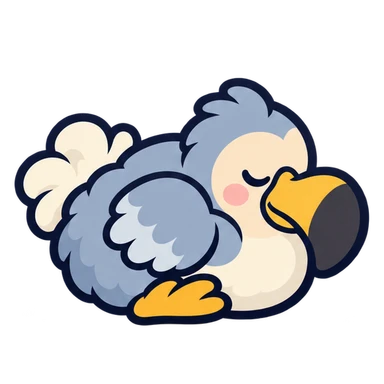
In short. The Queens puzzle is played on a square grid divided into coloured regions, as many regions as rows. You place one piece in every row, every column and every region, and no two pieces may touch, not even diagonally. A well-built grid has exactly one solution, reached by deduction, never by guessing. It is the one-star version of an older puzzle called Star Battle. In Dodoku, the pieces are dodos and the regions are gardens.
- 1Dodo per row, per column and per garden.
- 0Contact between two dodos, not even diagonal.
- 6Deductions, and every grid in the game yields to them.
The rule fits in four lines
The grid is square and cut into coloured regions, called gardens here. There are as many gardens as rows: seven rows, seven gardens. You put a dodo to bed:
- exactly once in every row;
- exactly once in every column;
- exactly once in every garden;
- and never right next to another one, not even on a corner.
The last point is the one people forget. Two dodos touching by a corner, diagonally, is forbidden too. The official reason is geometry. The unofficial one: a chubby dodo snores, and nobody wants to sleep next to it.
In the Queens game made famous by LinkedIn, the pieces are crowns. Elsewhere they are stars, cats or trees. The rule does not change by a single line, only the costume does.
The six deductions you need
A Queens grid is not solved by trying positions until something fits. It is solved by elimination. Six lines of reasoning are enough for every grid in the game, and they are exactly the ones its solver applies to check each level before sending it to you. They are also the ones the hint names.
1. Only one square left
A row, a column or a garden has only one free square left: the dodo goes there. This deduction finishes every grid, and starts the ones where a garden is a single square.
2. The garden that fits in one row
If every free square of a garden lies in the same row, its dodo will sleep in that row. The rest of the row is therefore ruled out, whatever gardens it crosses. The same goes for a column.
A A A B B
C C C C ×
D D A B B
D E E E B
D E E E E
3. The row that fits in one garden
The reverse argument. If every free square of a row lies in the same garden, that row will receive that garden’s dodo. The rest of the garden, outside the row, is ruled out.
4. The square that would empty a garden
The most visual of the six. Look at a small garden and find the squares that touch all of its free squares, or see them all along their row or column. A dodo there would leave that garden with no bed at all: the square is ruled out.
. × × .
× G G ×
. × × .
5. Two gardens inside two rows
If two gardens fit, between them, inside the same two rows, those two rows belong to them: their two dodos will fill them. Every other garden is ruled out of those rows. The same works with three gardens and three rows, and with columns.
6. Two rows that only cross two gardens
The reverse of the previous one. If the free squares of two rows only touch two gardens, those two gardens’ dodos will be in those two rows. Everywhere else, those gardens are ruled out.
Where to start
- Small gardens first. A garden of two or three squares has few possible beds, and it rules out many squares around it (deduction 4).
- Long gardens next. A garden lying along a single row, or standing in a single column, settles that line for everyone (deduction 2).
- Cross out as you go. Each square you rule out can leave another group with a single free square. That is where the grid starts solving itself.
- Look for pairs. When nothing moves any more, look for two gardens squeezed into the same two rows or columns (deduction 5).
The mistake that costs the grid: putting a dodo to bed because the square looks free, without proving it cannot go anywhere else. The game accepts it, since it breaks no visible rule, and the dead end arrives five dodos later, when a garden has no bed left. Tracking down the guilty dodo costs far more than the deduction you skipped.
Do not ask “where can I put a dodo?”. Ask “where can this garden still sleep?”. The second question has far fewer answers.
Why you never guess here
A correct grid has one solution and, above all, a path to it: at every step, at least one of the six deductions applies. Every Dodoku level is generated, then run past two solvers that share nothing. The first tries every placement and proves there is only one solution. The second only applies the six deductions, and if it gets stuck, the grid goes in the bin.
Difficulty is measured the same way: not by the size of the grid, but by the hardest deduction it requires. A 7 × 7 can be harder than a 10 × 10.
Where Queens comes from
The puzzle was first called Star Battle. It was created by the Dutch puzzle maker Hans Eendebak for the 2003 World Puzzle Championship. In its classic form you place two or three stars per row, column and region, on grids of 10 × 10 or more. The New York Times publishes a two-star version under the name Two Not Touch.
In May 2024, LinkedIn turned it into a mainstream daily game called Queens: a single piece per row, crowns instead of stars, coloured regions and smaller grids. Dodoku follows that one-star version. Dodoku is not affiliated with LinkedIn.
In this game
The gesture
A tap puts a dodo to bed. A long press, or a finger dragged across several squares, crosses them out: that is how you note that a square is ruled out. Tapping a dodo again gets it up, and Undo reverses your last move. The first three grids show you every gesture, with a finger pointing the way.
The snoring z’s
When a dodo goes to bed, a wave of little z’s runs from it across its row, its column, its garden and its neighbours. Those squares are taken, and they darken so the free ones stand out. It is not cheating: it is the direct consequence of the rule, nothing more. No grid can be solved with that alone.
No-help mode
If you would rather do everything yourself, untick “Mark taken squares automatically” in the “?” panel. No more z’s, and a misplaced dodo is accepted without a word: mistakes only show once the grid is full. A grid finished from start to end without help earns a moon ☾.
The hint explains before it answers
The first press lights up the group in question and spells out the deduction: “the pink garden has only one free square left”, or “the yellow garden fits entirely in row 3”. The second press makes the move for you. A hint never costs a star.
Stars
Three stars means no mistakes. A mistake is a dodo put to bed in a square that is not its own. The game counts it without flagging it, because saying “wrong” at every move would mean solving the grid for you. A finger landing on a square that is already taken does not count: the rule is shown, not punished.
Dodo of the day
Every day, three grids that are the same for everyone: the Nap (6 × 6), the Night (8 × 8) and the Hibernation (10 × 10). Your result can be shared as coloured squares, in the order you solved the gardens, without giving anything away. Your streak survives one missed day.
Frequently asked questions
What are the rules of the Queens puzzle?
Place one piece per row, per column and per coloured region, with no two pieces touching, not even diagonally. The grid has as many regions as rows, and a correct grid has exactly one solution.
Can two pieces touch diagonally?
No. Two pieces can never sit in neighbouring squares, whether side by side or by a corner. It is the rule people forget most often.
Do you ever have to guess?
No, if the grid is well built. Every Dodoku level is checked by a solver that only uses deductions: if anything had to be assumed to make progress, the grid would be thrown away.
What is the difference between Queens and Star Battle?
Queens is the one-star version of Star Battle: a single piece per row, column and region. Classic Star Battle often asks for two or three, on larger grids.
Can I play a game like Queens without LinkedIn?
Yes. Dodoku uses the same rule with dodos, free and without an account, in the browser or in the Pause app. It has a campaign, three daily grids and endless levels.
Why do the dodos snore?
It is the game’s way of explaining the touching rule: a chubby dodo snores, so nobody wants to sleep in its row, its column, its garden or right next to it.
Play Dodoku
One dodo per row, column and garden. Free, no account, works offline.
If you like this one
 One line puzzlesFill · Play now
 Pipe puzzlesRoll · Play now