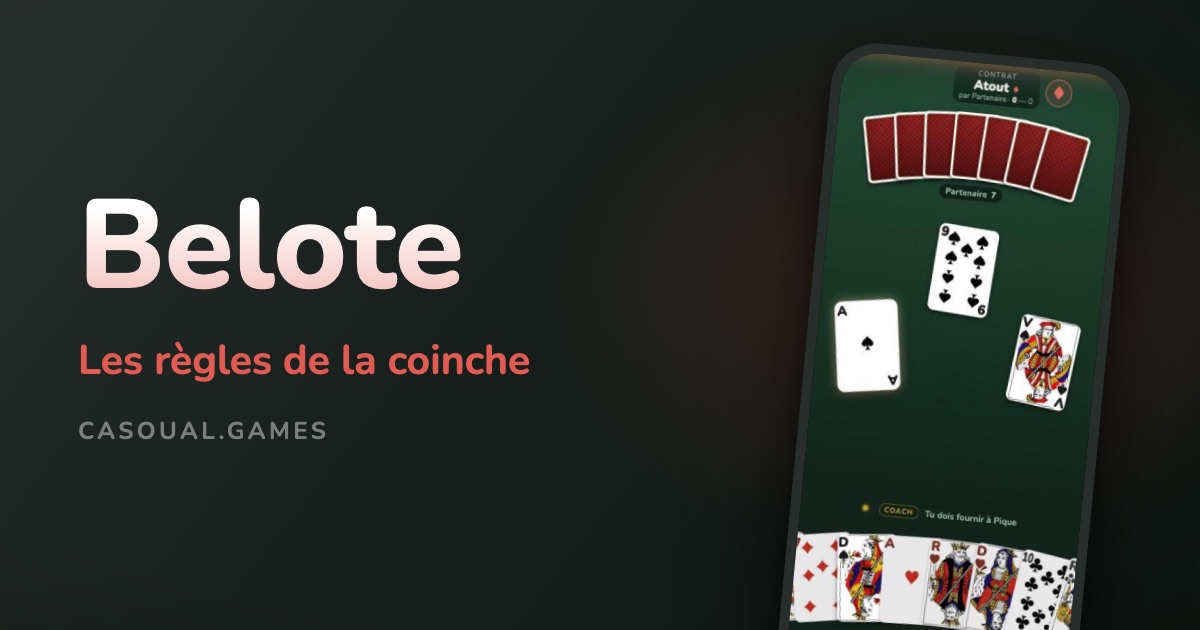
In short. Coinche is played four-handed, in two teams, with 32 cards. Before anyone plays, the players bid: the declarer promises a number of points, from 80 to 160, with a suit as trump. You then play 8 tricks. A deal is worth 162 points, 152 in the cards and 10 for the last trick. Reach the contract and the declarer scores; fall one point short and they drop to zero while the defence takes everything.
The goal
Coinche is played four-handed, in two teams. You and your partner, sitting across from you, against the other two.
Everyone gets 8 cards. You play 8 tricks: each player lays one card, and the strongest card takes the pile. Every card you take is worth points.
The first team to reach the agreed total, 501, 701 or 1000 depending on the game, wins. That takes five or six deals, about ten minutes.
Bidding and the contract
Before anyone plays, you talk. A bid is a promise: my team will score at least this many points, with this suit as trump.
Bids run from 80 to 160, ten at a time, and each one must beat the last. You can pass and bid again on your next turn, passing does not knock you out.
Slam (capot) is the big one: 250, a promise to win all eight tricks and leave the opponents nothing.
After three passes in a row, the last bid becomes the contract, and whoever made it is the declarer. The other two are the defenders. If all four players pass straight away, the cards are gathered up and dealt again.
Doubling and redoubling
Doubling, coincher, tells the declarer: you will never make it. The tricks and the contract then count double. If they are sure of themselves, they redouble, and everything counts quadruple. It is the best moment in the game, and the fastest way to lose one you thought you had won.
One thing escapes the multiplier: the 20 points of a belote, which stay 20 whatever happens.
Trump and how strong cards are
Trump is the suit named by the declarer. The smallest trump beats any card of any other suit.
And here is the part that trips everyone up when they start: cards do not have the same power, or the same value, in trump and out of it. There is no logic to look for, only two lists to know.
In trump
7 < 8 < Queen < King < 10 < Ace < 9 < Jack. The Jack is the strongest card in the game, the 9 comes right behind it.
| Card | Rank | Points |
|---|---|---|
| Jack | strongest | 20 |
| 9 | 2nd | 14 |
| Ace | 3rd | 11 |
| 10 | 4th | 10 |
| King | 5th | 4 |
| Queen | 6th | 3 |
| 8 | 7th | 0 |
| 7 | weakest | 0 |
Everywhere else
7 < 8 < 9 < Jack < Queen < King < 10 < Ace. Outside trump, the Jack and the 9 are worth nothing at all.
| Card | Rank | Points |
|---|---|---|
| Ace | strongest | 11 |
| 10 | 2nd | 10 |
| King | 3rd | 4 |
| Queen | 4th | 3 |
| Jack | 5th | 2 |
| 9 | 6th | 0 |
| 8 | 7th | 0 |
| 7 | weakest | 0 |
Short version: in trump, the Jack and the 9 come before everything. Everywhere else, the Ten and the Ace are in charge.
Belote and rebelote
If you hold the King and Queen of trump, your team gets 20 points automatically, the moment you play the first of the two cards. You say "belote" on the first and "rebelote" on the second.
Your belote cannot be lost, so never hang on to your trump King to "protect" it. Those 20 points are yours the moment the first of the pair hits the table, whatever happens to the trick.
What you are allowed to play
Whoever leads plays whatever they like. After that, in order:
- Follow the suit that was led, if you have it.
- If trump was led, play a higher trump than any already on the table, whenever you can.
- If you cannot follow suit, you must trump. Unless your partner is already winning the trick: then you may discard anything.
- If you trump after an opponent has trumped, you must go higher, if you can.
Two rules that surprise people, and that this game applies to the letter
No obligation to undertrump. If you have to trump but cannot beat the opponent's trump, you are free to discard an ordinary card instead of throwing away a small trump.
When trump is led, you always go higher, even when your partner is winning the trick. The "partner is winning" exception belongs to rule 3 only, never to rule 2.
Neither of these is an approximation: it is the literal reading of the rules, and all four players are held to it in exactly the same way.
A doubt about one specific trick? The move checker rebuilds the position and returns the engine’s verdict, in ten seconds.
How the points are counted
A deal is worth 162 points: 152 in the cards, plus 10 for winning the very last trick, the dix de der. At our table, reaching the contract is enough, belote-rebelote included; some federations also require beating the defence.
The declarer adds up everything their team took, plus 20 for a belote. Reach the contract and they score what they took plus the value of the contract, while the defenders keep their own points.
Fall one point short and they are down: nothing for them, and the defenders take 162 plus the value of the contract, plus 20 if the belote was theirs. Bidding high is a real risk.
A worked example
Contract of 110 in hearts. The declarer takes 124 points: the contract is made. They score 234 (124 + 110), and the defenders score 38.
Had they taken only 96, they would have been 14 points short: they would score 0, and the defenders 272 (162 + 110). Fourteen points of difference are worth 272 points on the board, that is the whole tension of the game.
Doubled, the tricks and the contract count double, and only the winning side scores. Redoubled, four times as much. The 20 of a belote are never multiplied.
The end of the game
The first team to reach the agreed total wins. If both teams cross it on the same deal, the higher total wins; on a perfect tie, one more deal is played.
Coinche or classic belote?
Both are played with the same 32 cards, the same orders and the same values. Only one thing changes: how the trump is named.
In classic belote, a card is turned face up in the middle of the table. Its suit becomes trump if somebody takes it, otherwise there is a second round where each player may name another suit. No bidding, no numbered contract, no doubling: you take, you play, you count.
In coinche, you announce a number of points and commit to it. It takes longer to learn and is markedly more tactical, the bid itself becomes a way of telling your partner what you hold.
If you are starting out, play a game or two of the classic version, long enough for the two card orders to sink in. The rest comes with playing.
In this game
Controls
Tap a card to play it: it lifts under your finger and travels to the middle when you let go. Slide too far before lifting and the play is cancelled. When bidding, pick a number then a suit; the bid button only lights up once you have both.
The coach
On your turn, cards the rules forbid are always dimmed, coach on or off. The setting only governs the line of explanation underneath, “you must follow hearts”, “you must trump”. When bidding, the advice comes from the Normal bot placed in your seat, not from a hand-written table.
What the game applies, and what it leaves out
Two variants with exactly the same card play: coinche, and the classic turned-card version. But no no-trump or all-trump, and no sequence or four-of-a-kind declarations, the only bonus is belote-rebelote. Coinche can be called once, by the defence.
Solo and online
Three bots at the table, at three levels, which differ in what they are allowed to remember rather than in added clumsiness. Your partner never trumps a trick you already hold. In 1v1, two humans sit side by side with a bot each opposite, and the server refereeing sends each player only their own view.
Coinche, also called belote contrée, is the bidding variant of belote. Where classic belote turns a card face up to name the trump, coinche lets the players fight over the contract at auction: that is what makes it tenser, and far more interesting four-handed.
Frequently asked questions
What is the strongest card in belote?
The Jack of trump, followed by the 9 of trump. Outside trump it is the Ace that dominates, ahead of the 10.
How many points are there in a deal?
162 points: 152 spread across the cards, 62 in trump and 30 in each of the three other suits, plus 10 points for the last trick, the dix de der.
What does "coincher" mean?
It means doubling the opponents' bid: you declare that the declarer will not reach their contract. Everything then counts double. If they stand by their bid, they redouble and everything counts quadruple.
Do you have to trump?
Yes, if you cannot follow the suit that was led, unless your partner is already winning the trick, in which case you discard freely. You are never obliged to undertrump, though: if you cannot beat an opponent's trump, you may discard instead.
Can belote-rebelote be lost?
No. The 20 points are secured the moment the first of the two cards is played, even if the opponents take the trick. They are never doubled by a coinche.
Are coinche and belote contrée the same thing?
Yes. "Coinche" and "belote contrée" name the same game: the variant of belote where the trump is decided at auction and where the opponents' bid can be doubled. The name varies from region to region.
What is the difference between belote and coinche?
The cards, the orders and the values are identical. In classic belote the trump is set by a card turned face up; in coinche it is settled by an auction in which the declarer commits to a number of points.
Can I play against a real person?
Yes, "Multi 1v1" seats you and one other player on adjacent seats, each with a bot partner opposite. The server referees the game and gives each player only their own view. If nobody is available after about ten seconds, it offers a table against three bots instead.
Play a hand
Coinche or classic belote, against three bots. Cards the rules forbid stay dimmed and the coach tells you why, you cannot go wrong while the rules sink in.
If you like this one

 One line puzzlesFill · Play now