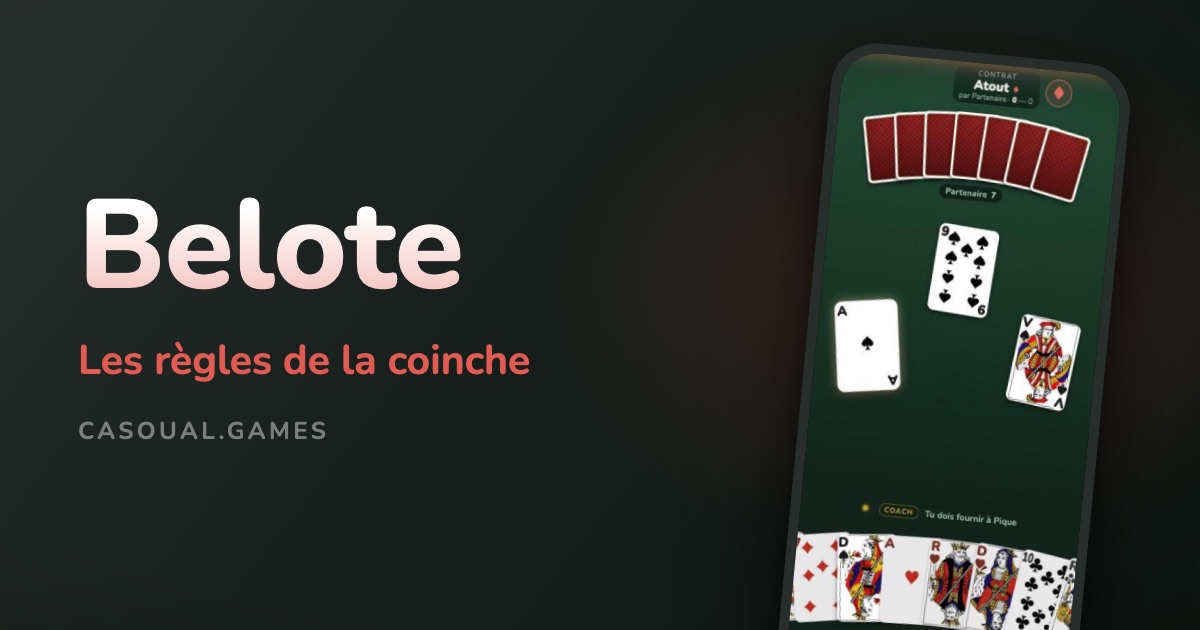
In short. Pick the trump suit, your seat in the trick, the cards already on the table and the ones you still held: the checker shows which cards you were allowed to play and explains why the rest were forbidden. It applies the five rules in the order they actually arise, follow suit, play over when trumps are led, trump, overtrump, otherwise play freely.
Nothing leaves your browser, the whole thing is computed on this page.
The five rules, in the order they arise
Belote card play is a decision tree, which is exactly why arguments break out: two rules can look like they apply at once. They never do. They are tested in this order, and the first one that matches settles it.
- Do you hold the suit that was led? If yes, you must play it.
- Was the suit led the trump suit? Then you must play over the highest trump already down, if you hold one. There is no partner exception here, this is the rule that surprises people.
- No card of the suit led? Then you must trump, unless your partner already holds the trick, in which case you are free.
- Has an opponent already trumped? Then you must overtrump if you can.
- Otherwise you play whatever you like, trumps included. Nothing forces you to undertrump.
The two situations that start the arguments
The theory fits in five lines. The trouble starts with four cards on the table.
Do I have to play over in trumps if my partner is winning?
The exception that frees you when your partner holds the trick is real, but it belongs to the trumping rule, not to following suit. If the trump suit itself was led and you hold trumps, you must climb over the best one already played, whoever is winning. Which is how a player ends up dropping the Jack of trumps, twenty points, the strongest card in the game, on a trick their own side had already won.
Do I have to undertrump if I cannot overtrump?
If an opponent has trumped and none of your trumps beats theirs, you are not required to throw a trump away underneath. You play whatever you like. Plenty of players believe the opposite, and this is exactly the kind of point another page of rules would not settle: you have to see the position arbitrated.
Two tricks rebuilt, and their verdict
Hearts are trumps. The 8 of hearts is led, your partner plays the Ace of hearts, the next opponent drops the 7. You hold the Jack of hearts, the King of diamonds and the 7 of spades. Your partner is winning with the strongest trump on the table after the Jack. Verdict: the Jack is your only legal card. The suit led is trumps, you hold one higher than the Ace, so you must play over. Twenty points on a trick your side already had. Open this trick in the checker.
Hearts are trumps. Spades are led: Ace of spades, 9 of spades, then the opponent trumps with the 9 of hearts. You have no spades. In hand: 7 and 8 of hearts, King of diamonds, Ace of clubs. Verdict: everything is legal, the King of diamonds as much as the 7 of hearts. The opponent is winning with a trump you cannot beat; nobody makes you undertrump. Open this trick in the checker.
What this tool does not do
It can tell you whether your play was legal. Whether it was smart is between you and your choices. Among the legal cards, which one to choose is strategy, and that is a different question.
It covers the ordinary contract, where one suit is trumps. All-trumps and no-trumps have their own tables and are not handled here.
Frequently asked questions
Do I have to trump if my partner is winning?
No. If you have none of the suit led and your partner holds the trick, you are free: trump, or discard any card. The duty to trump only applies when an opponent is winning. Careful, this does not apply when trumps themselves are led: there you must play over if you can, partner winning or not.
Do I have to enter all eight cards?
No. Enter the cards you still held at that moment. An argument that broke out on the seventh trick means two cards to enter, not eight, the engine never needed the original deal.
Can I send someone the answer?
Yes. “Share this verdict” builds a link that carries the whole position, so whoever opens it lands straight on the same verdict. Nothing is stored anywhere.
Is this the same as your Belote game?
The same engine, yes, the code that decides which cards are legal is a faithful port of the one running the real games, and a differential test replays both on hundreds of thousands of random positions.
Which belote is this?
French coinche, also called belote contrée. Card play is the same as in classic belote; only bidding and scoring differ.
Play a hand
Free in your browser, no account, against three bots, forbidden cards stay dimmed and the coach tells you why.
If you like this one
 One line puzzlesFill · Play now