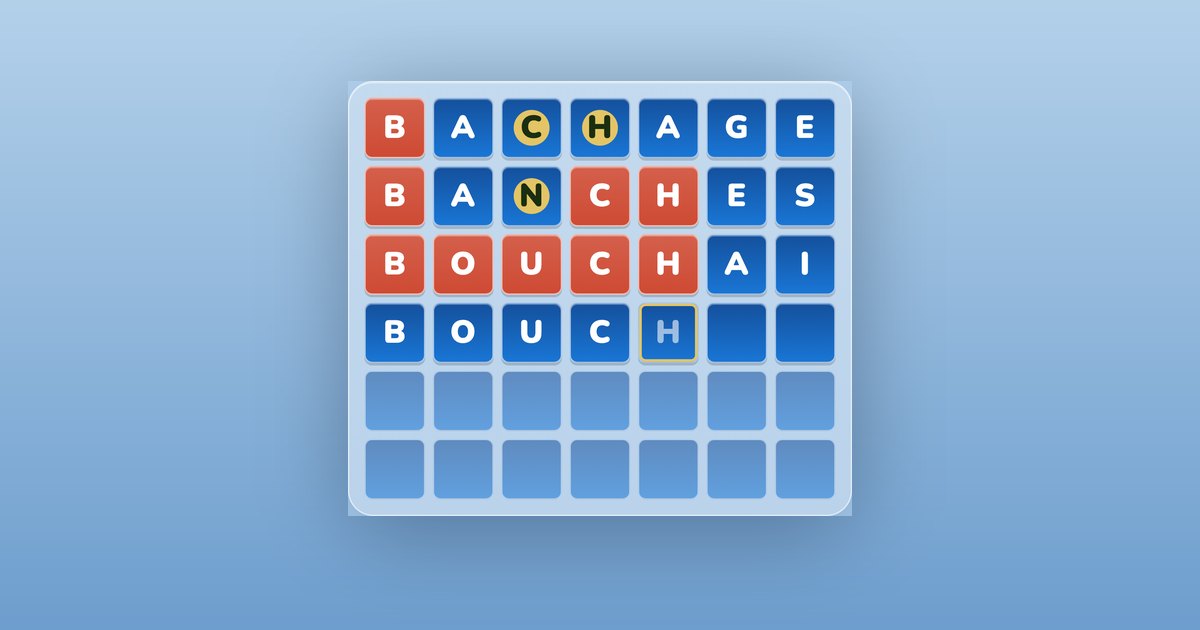
In short. Motus, the game known as Lingo in English-speaking countries, is a hidden word of five to nine letters to find in six tries. The first letter is given. After each try, the grid answers letter by letter: red if the letter is in the right place, a yellow circle if it is in the word but somewhere else, nothing if it isn’t there at all. Red letters carry over to the next row. It is the format of the show broadcast on France 2 from 1990 to 2019, itself adapted from the Dutch Lingo of 1989.
Where Motus comes from
Motus was a television game show broadcast on Antenne 2, later France 2, from June 25, 1990 to August 31, 2019, twenty-nine seasons, almost all of them hosted by Thierry Beccaro. Two teams competed over words of six to eight letters, with a phrase that became proverbial for announcing a rejected word: “Motus!”
The format is not French. Motus is an adaptation of Lingo, a show created in the United States in 1987 and popularized above all by its Dutch version, produced by VARA from 1989 onward. That is the version that fixed what everyone knows: the blue grid, the correctly placed letter in red, the letter present elsewhere in a yellow circle, and the beeps that go with each reveal. Those beeps have traveled through every adaptation unchanged.
Thirty years on air planted that grid in people’s heads long before Wordle. When Sutom brought the format to the web in 2022, it had nothing to explain.
Motus, Wordle, Sutom: what changes
All three games rest on the same idea, a hidden word, tries, colors, but two rules make Motus a different game from Wordle.
- The first letter is given. In Wordle you start from nothing, and the first try is almost always the same word learned by heart. In Motus, every grid sets a constraint from the outset, and the first try already asks you to think.
- The length varies. Wordle is five letters, always. Motus runs from five to nine, and a nine-letter word isn’t hunted the way a five-letter one is: you reason by prefixes, suffixes and word families.
- The colors aren’t the same. Wordle says green and yellow; Motus says red and a yellow circle. That isn’t vanity: it is the memory of the show, and it is what makes the grid recognizable from across the room.
- Found letters carry over. On the show, a red letter stays red on the next row. Here too.
Sutom is a faithful Motus, online, with one word a day. Motzen keeps the grid and the rules, and adds what one word a day can’t offer: as many games as you like, five lengths, six languages, and hints.
Reading the colors, and the double-letter trap
Red and yellow aren’t read letter by letter: each letter of the hidden word can only “pay” once. That is where most players go wrong, and most clones too.
hidden word B A N A N E
guess       A N A N A S
            ◯ ◯ ◯ ◯ · ·

the first three A/N are present elsewhere;
the fourth A comes out ABSENT: both A’s in the word
are already taken
The exact rule runs in two passes: first the correctly placed letters, which claim their letter as a priority; then the others, left to right, each taking a letter that is still available if any remain. An absent letter next to an identical letter in red therefore doesn’t mean “not in the word”: it means “not a second time.”
The strategy in thirty seconds
- First try: a common word, five different letters, using the most frequent letters of the language. You are not trying to win, you are trying to sort.
- Second try: keep the reds where they are, move the yellows, ban the greys. A word compatible with everything you know, even if it looks unlikely.
- Count what is left. If three candidates differ by one letter only, play a probe word that contains those three letters rather than trying one at random.
Where to start
The first letter changes everything. On a seven-letter word, it divides the number of possible solutions by twenty from the outset. So the first try doesn’t need to be a magic word learned by heart: it needs to be a common word that starts with the right letter and spreads out frequent letters, without repeating any.
- The letters that pay off most in English: E, A, R, O, T, I, N, S, then L, C. A first try that places five or six different ones teaches you a lot, whatever the answer.
- Don’t double any letter on the first try. A second A tests only one more thing: are there two A’s? That is rarely the question at this stage.
- Think about endings. In English, -ING, -ED, -ER, -ES and -TION come up again and again. A yellow E or R at the end of a word says a lot about what follows.
- On long words, look for families. At eight or nine letters, common words are often derivatives: a prefix (RE-, UN-), a root, a suffix (-NESS). Find the root and you’ve found the word.
Probe, rather than guess
Sometimes you hesitate between three words that differ by a single letter. PLANE, PLATE, PLACE. Trying them one by one can cost three tries. Better to play a word you know is wrong but that contains the letters that tell them apart: one try answers all three questions. That is why eliminated letters stay playable.
Read what the grid has already said
Before each try, reread the previous rows as a list of constraints: the reds fix positions, the yellows say “elsewhere”, and “elsewhere” rules out the square where the yellow appeared. A word that puts a yellow letter back in the same spot is a try lost before it starts.
For the curious: the sound and the colours
The sound: the better the news, the higher the beep
On the show, the colors aren’t the only thing carrying information. Every revealed letter comes with a beep, and the three beeps differ only in pitch: low for an absent letter, medium for a letter present elsewhere, high for a correctly placed one. The coding is so clear that you can follow a round by ear, without looking at the screen.
Motzen takes up that grammar, synthesized in the browser without a single audio file: the same voice, a softened square wave, for all three beeps, only the pitch changes, and a 220-millisecond gate that gives the reveal its rhythm. The found word has its own jingle: a quick run upward, one note every 53 milliseconds, resolving on the pitch of the correct letter. And since nothing is loaded, the sound works offline like everything else.
The colors, and why the grid stays readable for everyone
The default style takes its tones from the studio set: a mid blue for the squares, shading from dark to light, the soft red of the correctly placed letter, the golden yellow of the circle. They were sampled from a still of the show, then adjusted just enough to stay readable on a screen held thirty centimeters away, a television grid is viewed from farther off.
The three states never rely on color alone: a correctly placed letter fills the whole square, a letter present elsewhere sits on a disc, an absent letter stays on the bare square. A color-blind player tells the three apart by shape, and each of the seven color styles has been checked so that the difference in lightness between states is enough even in grayscale.
The dictionaries
Each language has two lists. The first, the broad one, holds everything you are allowed to type, more than a hundred and thirty thousand words in French, a hundred and fifty thousand in English, two hundred and fifty thousand in Spanish. A rare but real word is never refused. The second, the narrow one, holds what the game may ask you to find: common words, chosen from the most frequent in writing and in speech. Losing on a word you have never read isn’t hard, it’s unfair.
No proper nouns, no compound words, no abbreviations. Accents aren’t typed, the dictionary is normalized, and the word is shown with its accents once found.
Where to play
Motzen plays in a browser, on phone or computer, with no download and no account. It’s free. The word of the day is the same for everyone in a given language; free play offers as many as you like.
In this game
The rules
- A word of five to nine letters, your choice. The first letter is given; you have six tries to find the rest.
- You type the whole word, first letter included: it feels more natural than picking up in the middle, and it lets you write what you want where you want.
- What you already know, the given letter, the correctly placed letters from earlier tries, shows as a watermark on the current row. You still have to type it, but you don’t have to remember it.
- A word has to exist in the dictionary. Every valid word is accepted, even rare ones; the word to find, though, is always a common one.
- No timer. The game is called Motzen for a reason.
What helps
- The light bulb reveals a letter in its place, as if you had found it. Each hint costs a short video, as many times as you like, as long as there is something left to reveal.
- Out of tries after six? A video buys you a seventh, then an eighth. Never more: that is the only limit.
- Eliminated letters go dark on the keyboard but stay playable. You might want to try a word you know is wrong, just to test a combination.
- Tapping a square puts the cursor there. When only one letter is left to change, you don’t retype the whole word.
What you can adjust
- Seven color styles, from the original studio blue to a charcoal for playing in the dark, by way of paper, sage and lilac.
- Six game languages, French, English, Spanish, German, Italian, Portuguese, each with its own dictionary and keyboard layout. You can play in Spanish with an English interface.
- The dictionaries are built in: once the page has loaded, the game works without a connection.
Frequently asked questions
Is Motus the same thing as Wordle?
No. The two games share the idea of a hidden word and colors, but Motus gives you the first letter, varies the word length from five to nine, carries found letters over to the next row, and codes its answers in red and a yellow circle. Motus has also been around since 1990, Wordle since 2021.
Why is the first letter given?
It has been the rule of the show since Lingo. It changes the way you play: every grid sets a constraint from the outset, and the first try asks you to think instead of reciting a word learned by heart. On a seven-letter word, it divides the number of possible solutions by twenty from the outset.
What do red and the yellow circle mean?
Red: the letter is in the word, in that spot. Yellow circle: the letter is in the word, but somewhere else. Nothing: it isn’t there, or it is, but all its occurrences are already claimed by red or yellow letters. That is the case with doubled letters, and it is the classic trap.
How many tries do you get?
Six, as on the show. A short video buys a seventh, then an eighth, never more. Hints have no limit: each costs a video and reveals a letter in its place.
Can you play offline?
Yes. The dictionaries for all six languages are built into the game and the sounds are synthesized on the spot: once the page has loaded, nothing is asked of the network.
Why “Motzen”?
Because “Motus” is the name of a show that doesn’t belong to us, and because there is “zen” in it. The game has no timer: you take your time, ask for a hint if you like, and nobody is counting.
Play Motzen
Motus online, from five to nine letters, in six languages. Free, no account, no timer.
If you like this one
 One line puzzlesFill · Play now