In short. Mahjong Solitaire is played alone, with mahjong tiles stacked in several layers. You remove tiles in identical pairs, as long as each one is free: nothing sits on top of it, and its left side or its right side is open. Any two flowers make a pair, and so do any two seasons. You win when the board is empty and lose when no free pair is left, so the order in which you remove tiles is everything.
- 2conditions to remove a tile: a twin, and room to move.
- 144tiles in a full set, the one the classic Turtle uses.
- 0timers. Think at your own pace.
The goal: clear the board
The tiles form a pile, sometimes a tall one. You take two at a time, always two identical tiles, and you win when not a single one is left. No points to count, no opponent, no clock ticking: just you and a pile that melts away.
There is only one condition, but it makes the whole game: a tile can only go if it is free.
Free or blocked: the one rule to get
A tile is free when you could slide it out of the pile without disturbing the others. In practice, two conditions:
- Nothing sits on top of it, not even the corner of another tile.
- Its left side or its right side is open. One of the two is enough.
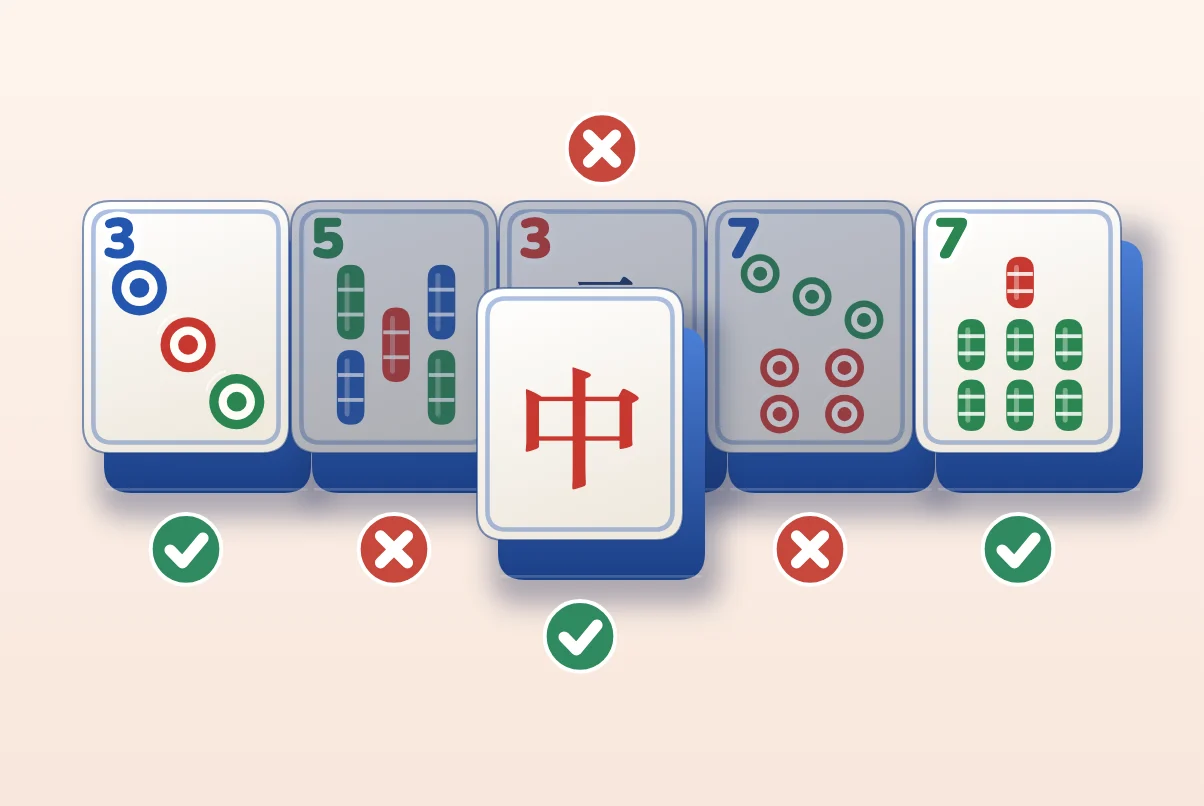
The classic mistake: thinking a tile is blocked by the row above or below it on screen. Only its left and right neighbours count, plus whatever is stacked on it.
The tiles, suit by suit
A mahjong set most commonly has 144 tiles, sorted into suits. For solitaire you do not need to read them: you only need to spot two that look the same. Still, knowing what you are looking at makes pairs much easier to find.
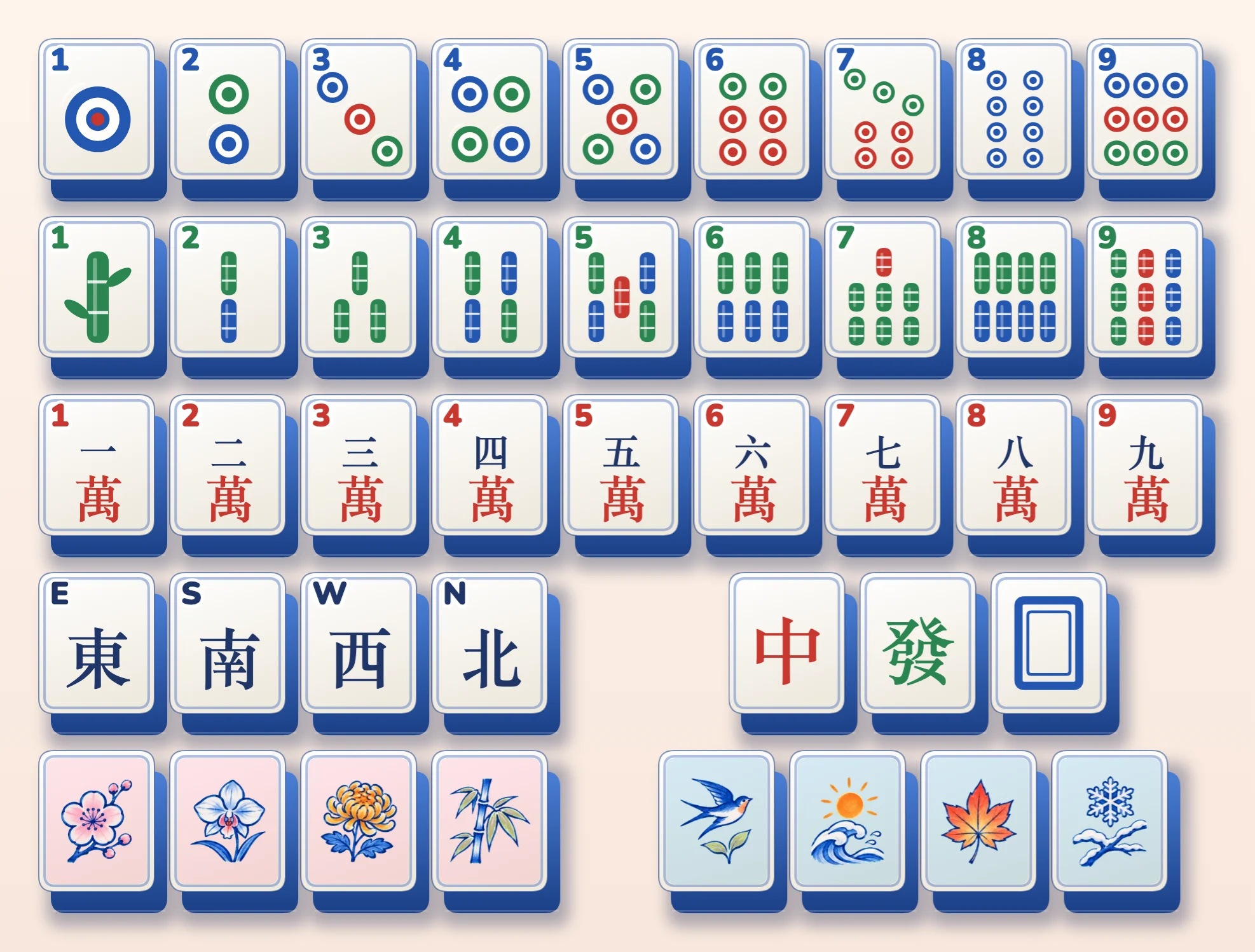
| Suit | Tiles | Pairs with |
|---|---|---|
| Dots | 1 to 9 (×4) | the same |
| Bamboo | 1 to 9 (×4) | the same |
| Characters | 1 to 9 (×4) | the same |
| Winds | East, South, West, North (×4) | the same |
| Dragons | red, green, white (×4) | the same |
| Flowers | plum, orchid, chrysanthemum, bamboo (×1) | any flower |
| Seasons | spring, summer, autumn, winter (×1) | any season |
Two suits need a little care. Each flower exists only once, but any two flowers make a pair. Same for the seasons among themselves. A flower, however, never pairs with a season.
Two fun facts for your next family dinner: the “bamboo” sticks are really strings of coins, and the character 萬 on the third suit translates as “myriad”.
The three-tile trap
This is THE situation that beats beginners. Most tiles come in four copies. Picture three of them free at the same time: you may remove any two, except that the fourth one may be buried somewhere.
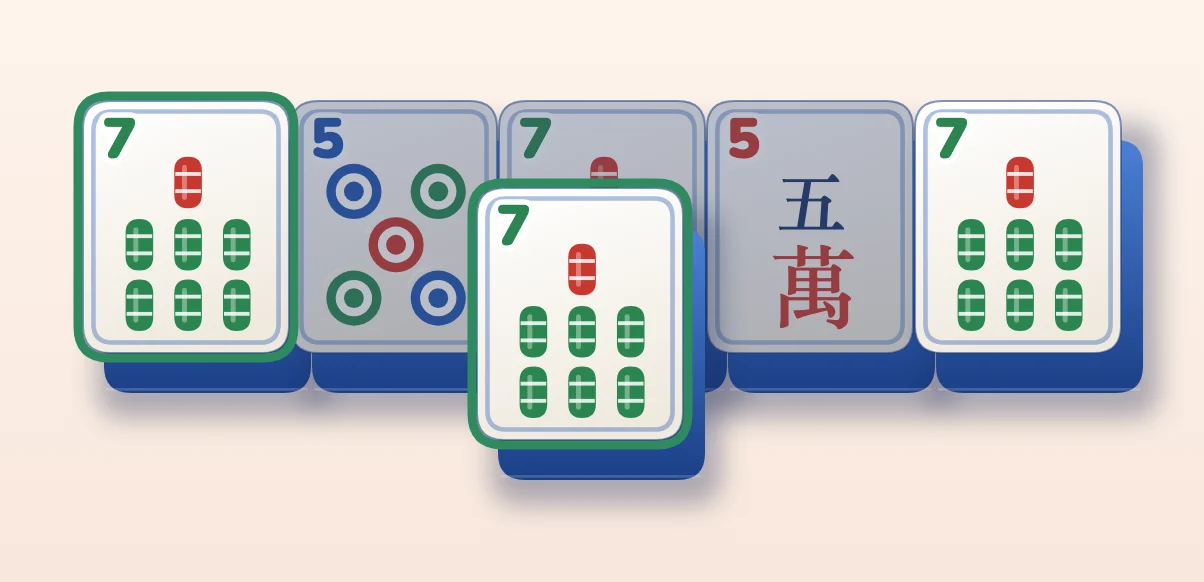
If you take the two tiles at the ends, you are left with the top one and the one it covers. The lower tile will only be free once the top one is gone, and the top one has no other partner left: dead end. The game is lost, even with a hundred tiles still on the board.
Three matching tiles free? Remove the one sitting on other tiles first. More often than not, that is where the fourth one hides.
Five habits that clear the board
- Start with the risk-free pairs. When every remaining copy of a tile is free, removing them can never cost you the game.
- Go for the top of the piles. A top tile often hides several others: removing it opens the game up.
- Open the long rows early. A row of ten tiles only frees up from its two ends: the sooner you start, the more choice you will have.
- Apply the rule of three. Three copies free: your pair must include the one resting on other tiles.
- Do not grab a pair just because it is there. If it frees nothing, it can wait: a free tile stays free until you take it.
Where does Mahjong Solitaire come from?
The tiles come from China: the oldest surviving mahjong sets date to the 1870s, and they were made for a four-player game.
The solitaire version was born on a screen. Brodie Lockard programmed it in 1981 on the PLATO system, and Activision released it in 1986 as Shanghai. Its default layout, the Turtle, uses all 144 tiles.
A randomly dealt board does not always have a solution: out of ten million turtles analysed, about 3 percent cannot be solved, even when looking under the tiles is allowed. In Mahjong, every board is built backwards from a solution, so it always has one.
In this game
- Blocked tiles are shaded: you only search among the bright ones. Tap a shaded tile and the game shows you what holds it back.
- A number in the corner of dots, bamboo and characters, a letter on the winds: no more counting sticks.
- Flowers on pink, seasons on blue: the colour tells you what each tile can pair with.
- Undo is free and unlimited. Hints and shuffles cost a short video, and a shuffle always leaves a solution.
- Two hundred levels that teach one thing at a time, then endless boards. Never a timer.
Frequently asked questions
How do I know if a mahjong tile is free?
It is free if no tile sits on top of it and its left side or its right side is open. Tiles at the top of the piles and at the ends of rows are therefore the first that can go.
Can a flower match a season?
No. Any two flowers make a pair, and so do any two seasons, but a flower never pairs with a season.
Can every game of Mahjong Solitaire be won?
Not when the tiles are dealt at random: about 3 percent of turtles have no solution at all. In Mahjong, every board is built from a solution, and a shuffle always leaves one.
What should I do when there are no pairs left?
Undo your last moves, for free, and try another order. Or shuffle the remaining tiles for a short video: the game redeals them so that a solution remains.
How many tiles are in a mahjong set?
Most commonly 144: four copies of each dot, bamboo and character from 1 to 9, of each of the four winds and three dragons, plus four unique flowers and four unique seasons.
Do I need to know four-player mahjong?
No. Solitaire only keeps the tiles: you just need to spot two matching ones, with no hands to remember and no points to count.
If you like this one
 One line puzzlesFill · Play now
 Pipe puzzlesRoll · Play now